
The Enterprise Doesn’t Need Another Framework. It Needs a BRIDGE.
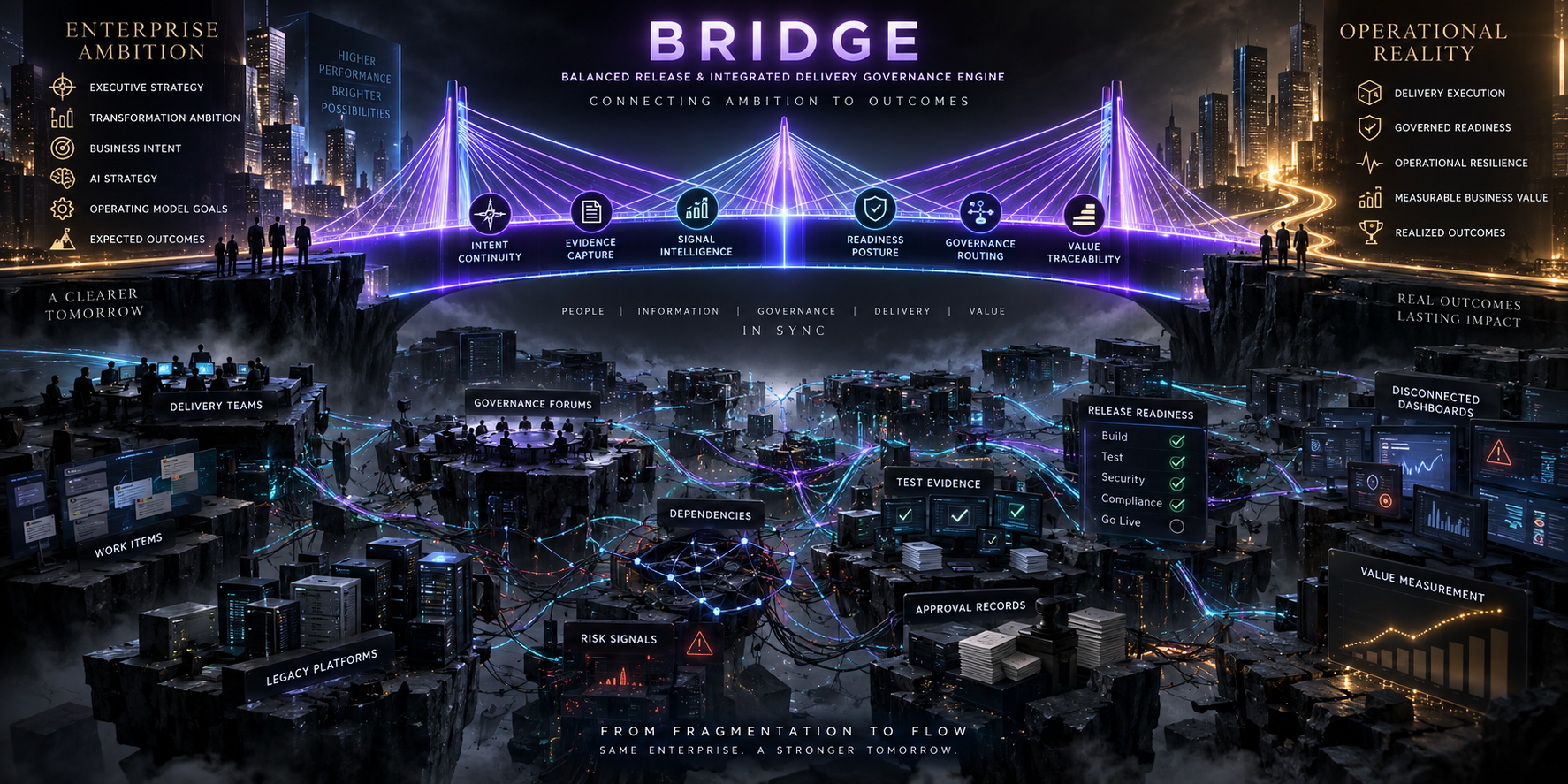
Published on Sep 21, 2026
The Enterprise Doesn’t Need Another Framework. It Needs a BRIDGE.
A lightweight operating model for the messy middle between strategy and execution.
The hard part is not writing the strategy. The hard part is keeping the strategy connected to execution after reality starts throwing elbows.
Large enterprises do not have a shortage of frameworks.
They have plenty. Some would even say, too many.
Frameworks for strategy.
Frameworks for delivery.
Frameworks for agile transformation.
Frameworks for governance.
Frameworks for risk.
Frameworks for value realization.
Frameworks that come with color-coded maturity models, 73-slide operating model decks, process diagrams with too many arrows, and enough terminology to make an otherwise normal person start quietly rooting for the spreadsheet.
And yet, after all that structure, the same thing keeps happening.
The business vision gets declared.
The roadmap gets approved.
The funding gets allocated.
The delivery teams get moving.
The governance forums get scheduled.
The dashboards light up.
Then, somewhere between strategy and execution, the enterprise starts losing the thread.
Intent gets diluted.
Dependencies get discovered late.
Risk signals hide in meeting notes.
Evidence gets reconstructed under deadline pressure.
Release readiness turns subjective.
Business value becomes a slide from six months ago that everyone vaguely remembers but nobody can trace cleanly to what shipped.
That is not a framework shortage.
That is a connection problem.
Deloitte’s 2026 AI transformation research makes the same broader point in the AI context: deployment is no longer the hard part for many organizations; the deeper challenge is redesigning how work gets done, governing autonomy, and measuring value clearly. The research also notes that nearly half of respondents have introduced AI without redesigning the workflows or roles around it, while only 12% report redesign at scale with a new operating model behind it. source
That is the messy middle.
Not the vision.
Not the demo.
Not the methodology poster.
The messy middle is where strategy, work, governance, evidence, risk, decisions, operating model change, and value have to stay connected long enough for anything meaningful to happen.
That is the space BRIDGE is designed to occupy.
The Short Version
If you only remember five things from this article, make them these:
- Enterprises do not need another monolithic framework dropped from the sky.
- The real problem is that strategy, execution, governance, evidence, signals, and value are usually disconnected.
- BRIDGE is a lightweight operating model for the messy middle between enterprise ambition and operational reality.
- BRIDGE is not meant to replace agile, waterfall, product operating models, governance, or AI strategy. It is meant to connect the pieces that already exist.
- In an AI-forward enterprise, the ability to preserve intent, surface signals, govern change, and trace value may become the difference between transformation and expensive theater.
The Framework Fatigue Problem
Let’s be honest.
The enterprise world has a framework problem.
Not because frameworks are inherently bad.
They are not.
A good framework gives people shared language, structure, decision clarity, and a way to reason about complex work without starting from scratch every Tuesday.
That can be useful.
The problem is what happens when a framework becomes a monument.
A monument needs guardians.
Guardians need compliance.
Compliance needs templates.
Templates need reviews.
Reviews need dashboards.
Dashboards need steering committees.
At some point, the enterprise is no longer improving delivery.
It is maintaining a shrine to process.

Frameworks are useful until the enterprise starts serving the framework instead of the outcome.
This is how transformation fatigue sets in.
Teams are not always resisting change because they are cynical, lazy, or allergic to maturity.
Sometimes they are resisting because they have lived through enough “new ways of working” to know the pattern.
A new model arrives.
A new vocabulary appears.
A new dashboard gets built.
A new governance forum gets added.
A new template becomes mandatory.
And somehow the actual work gets heavier.
That is not transformation.
That is administrative inflation with better branding.
BRIDGE is intentionally not designed to be that.
BRIDGE should not become another giant framework poster that looks impressive in a conference room and collapses on contact with a shared test environment.
The idea is simpler:
Connect the work.
Preserve the intent.
Capture the evidence.
Surface the signals.
Govern the risk.
Trace the value.
Do all of that without crushing the teams inside the system.
The Messy Middle
Most enterprise transformation stories are told from the top or the bottom.
At the top, everything looks strategic.
Executive priorities. Market shifts. AI ambition. Customer outcomes. Technology bets. Operating model reinvention. Value pools. Target-state capabilities. Very polished. Very expensive. Often accompanied by a blue gradient.
At the bottom, everything looks real.
Backlogs. Defects. Environment conflicts. Dependency issues. Data gaps. Release windows. Risk acceptances. Test evidence. Integration failures. Teams trying to make the actual machine run while the future state hovers overhead like weather.
The messy middle is where those worlds are supposed to connect.
They often do not.

The messy middle is where enterprise ambition either becomes execution or becomes another beautiful artifact nobody can operationalize.
This is where programs lose momentum.
Not because nobody cares.
People care plenty.
The issue is that the enterprise system usually fragments across its own seams:
- strategy lives in executive materials
- work lives in delivery tools
- evidence lives in test systems and approval workflows
- risks live in RAIDD logs, meeting notes, and people’s heads
- governance lives in forums and checklists
- value lives in business cases and benefits decks
- decisions live in email threads, meeting recordings, exceptions, and folklore
Then the organization asks leadership to make confident decisions from disconnected truth.
That is how smart people end up in a room squinting at three dashboards, two spreadsheets, a release checklist, and one person who “remembers what happened.”
A modern enterprise should not have to rely on memory as middleware.
Why AI Makes the Problem Bigger
AI does not reduce the need for operating model discipline.
AI exposes how little of it was actually there.
The World Economic Forum’s 2026 AI Playbook for Financial Services describes AI as a structural disruption that changes how work is organized, how decisions are made, how value is created, and how institutions compete and collaborate. The report also emphasizes the need for strong foundations across platform architecture, skills, governance, risk, compliance, security, model risk, human-AI partnership, leadership, sponsorship, and accountability. source
That is not a tooling upgrade.
That is an operating model stress test.
AI strategy creates new questions that legacy delivery and governance models are not always built to answer:
- Which workflows should be redesigned instead of merely accelerated?
- Which decisions can be automated, augmented, or agent-assisted?
- Where does human judgment remain non-negotiable?
- How does the organization govern autonomous or semi-autonomous action?
- How does AI adoption connect to measurable business value?
- How does risk evidence get captured as work happens?
- How does leadership know whether transformation is actually landing?
These are not side questions.
These are the questions.
Deloitte’s 2026 operating model research argues that scaling AI requires rewiring how the enterprise makes decisions, allocates capital, governs risk, and gets work done. It also frames the future operating model as less about where functions sit on an org chart and more about how leadership, work, capital, risk, and ecosystem relationships are coordinated around business outcomes. source
That is precisely where BRIDGE becomes relevant.
Not as an AI strategy replacement.
Not as another AI governance framework.
As the connective operating layer between ambition and execution.
Because AI programs do not fail only because models are weak.
They fail because intent gets unclear, process redesign stalls, controls arrive late, data readiness gets overstated, adoption is measured instead of value, and governance cannot tell what is happening until the program is already making expensive noises.
In other words, AI does not eliminate the messy middle.
AI puts the messy middle under fluorescent lighting.
Introducing BRIDGE
BRIDGE stands for:
Balanced Release & Integrated Delivery Governance Engine.
That name started from the practical realities of hybrid enterprise delivery: agile development, structured testing, governance, release readiness, audit evidence, dependency management, and business value expectations all trying to coexist without turning every release into a ritual sacrifice.
But the larger idea is broader than release management.
BRIDGE is a lightweight operating model for helping complex enterprises connect:
- business intent
- delivery execution
- governance
- evidence
- risk and dependency signals
- readiness posture
- value realization
- automation opportunities
- and eventually, human-AI ways of working
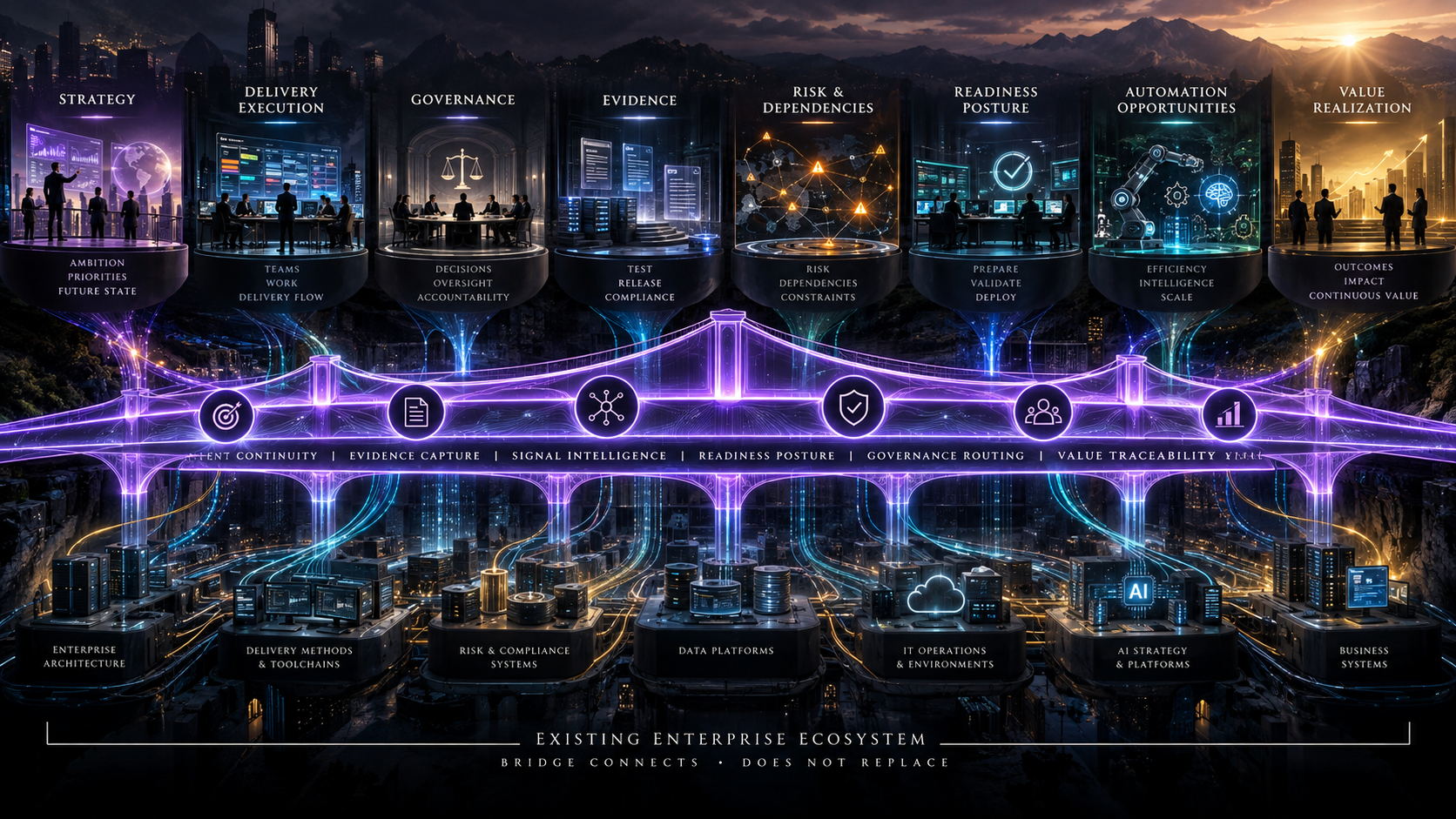
BRIDGE is not another wall of process. It is connective tissue for the enterprise work that already exists.
The point is not to replace what organizations already use.
Most enterprises are not waiting around for one more methodology to save them.
They already have delivery models.
They already have governance.
They already have tooling.
They already have metrics.
They already have risk processes.
They already have AI strategy conversations.
The problem is that those pieces do not reliably connect.
BRIDGE is designed to make the connections visible, usable, and governable without forcing every team into a giant new operating religion.
What BRIDGE Is
BRIDGE is an operating model concept for the messy middle.
It is designed around a simple belief:
Enterprise transformation fails when intent, execution, evidence, signals, and value stop traveling together.
BRIDGE tries to keep those things connected.
At its best, BRIDGE should help leaders answer questions like:
- What was the original business intent?
- What work is actually moving against that intent?
- What evidence exists that the work is ready?
- What risk remains?
- Which dependencies are exposed?
- Which decisions changed the shape of the work?
- Which signals suggest the program is drifting?
- What value was expected?
- What value can be traced after release?
- Where should deterministic automation, generative AI, or agentic AI assist the model?
That is not bureaucracy.
That is memory.
That is visibility.
That is decision support.
That is an enterprise delivery system trying not to lose its own plot.

BRIDGE starts with a simple idea: the thread should not break just because work moves across teams, tools, or governance layers.
What BRIDGE Is Not
BRIDGE is not a replacement for agile.
BRIDGE is not a replacement for waterfall.
BRIDGE is not a replacement for product operating models.
BRIDGE is not a replacement for ITIL, DevOps, enterprise architecture, model risk management, audit, compliance, or common sense.
It is also not an excuse to create another governance maze where delivery teams have to carry a compliance backpack full of bricks.
BRIDGE should not become a paperwork tax.
BRIDGE should not become a meeting factory.
BRIDGE should not become a new shrine to process.
BRIDGE should not require teams to manually re-enter delivery truth into yet another tool because leadership wanted the illusion of maturity by next Friday.
If BRIDGE becomes that, then BRIDGE has failed.
The design principle has to be this:
Improve connected visibility without adding unnecessary drag.
That is the bar.
Not “did we add control?”
Not “did we create a new dashboard?”
Not “did we invent more fields?”
The better question is:
Did the system become easier to understand, easier to govern, easier to trust, and easier to move?
If not, congratulations, you have probably built another enterprise treadmill.
The Core Jobs of BRIDGE
BRIDGE has several core jobs.
Not 47.
Not a sacred scroll.
A few that matter.
1. Preserve intent
Enterprise work starts with intent.
Why are we doing this?
What business outcome matters?
What customer, operational, regulatory, financial, or strategic result is supposed to change?
If that intent gets diluted across epics, features, stories, test plans, defects, approvals, change records, and release notes, the organization ends up validating artifacts instead of validating outcomes.
BRIDGE should help the system remember why the work exists.
2. Capture evidence as work moves
Evidence should not be rebuilt at the end like a crime scene reconstruction.
Testing results, approvals, exceptions, risk decisions, dependency dispositions, readiness signals, and value assumptions should accumulate as work moves.
That does not mean every team gets buried in manual updates.
It means the operating model should know which evidence matters and design for capture instead of panic.
3. Surface signals early
Most enterprise trouble signals show up before the executive escalation.
They appear in meeting notes.
Status language.
Repeated deferrals.
Dependency comments.
Environment conflicts.
Unstable test evidence.
Scope changes.
Risk acceptances that sound just a little too breezy.
BRIDGE should make those signals harder to miss.
4. Connect governance to flow
Governance should increase confidence without suffocating motion.
That means governance must be risk-aware, evidence-driven, and connected to actual delivery signals.
A gate that asks for evidence nobody captured is not governance.
It is punishment with an agenda.
5. Trace value
Business value cannot disappear after approval.
If the enterprise funded the work because a value story existed, that story needs a thread from intent to delivery to adoption to outcome.
BRIDGE should help keep that value thread alive.
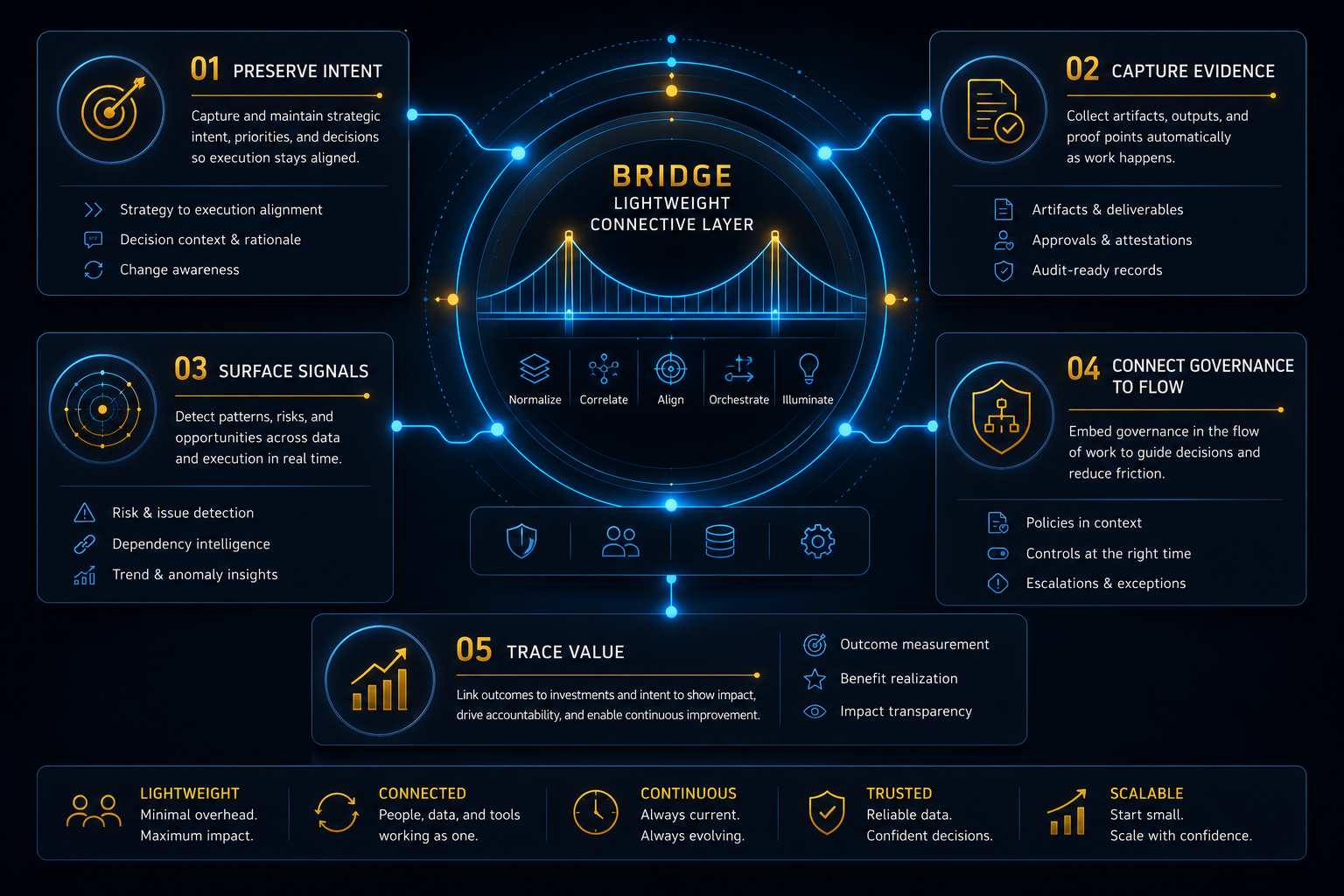
The core job of BRIDGE is not to add ceremony. It is to keep the important threads connected.
Where BRIDGE Fits
BRIDGE fits between the places where large enterprises usually drop the ball.
Between strategy and delivery.
Between agile teams and enterprise governance.
Between AI pilots and scaled operating model change.
Between release readiness and business value.
Between risk signals and executive decisions.
Between current-state operating reality and future-state operating ambition.
That last one matters.
Because the next generation of enterprise transformation is not only about adopting AI.
It is about redesigning how work, decisions, controls, people, platforms, data, and value move together.
The 2026 Deloitte State of AI in the Enterprise research says AI adoption and production expectations are rising, but only 34% of companies are deeply transforming their business, and agentic AI usage is expected to rise sharply while mature governance of autonomous agents lags. source
That creates exactly the kind of transition problem BRIDGE can help with.
Not by declaring itself the future state.
That would be obnoxious.
BRIDGE is more useful as the bridge between states:
- current tools and future intelligence layers
- current governance and future autonomy models
- current delivery signals and future decision systems
- current value cases and future outcome management
- current process friction and future human-AI operating models

BRIDGE can serve as the transition layer between how the enterprise works today and how it wants to work tomorrow.
That is a much better role than pretending the enterprise can leap directly from fragmented current state to AI-native operating model because a strategy deck said so.
Large organizations do not leap.
They transition.
Sometimes gracefully.
Sometimes like a refrigerator being moved down a staircase.
BRIDGE is meant to make the transition less ridiculous.
How BRIDGE Connects to CLEAR and RADAR
BRIDGE is the operating model umbrella.
CLEAR and RADAR are designed to be BRIDGE modules with specific capabilities.
CLEAR helps the system remember.
RADAR helps the system see.
That is the cleanest way to explain it.
CLEAR
CLEAR focuses on preserving change intent, launch readiness, evidence continuity, and the thread between business purpose and delivery execution.
If BRIDGE asks, “How do we keep intent connected to readiness and value?” CLEAR helps answer that.
RADAR
RADAR focuses on surfacing hidden risks, dependencies, decisions, blockers, and weak signals from the noise of complex program execution.
If BRIDGE asks, “How do we see trouble early enough to act?” RADAR helps answer that.
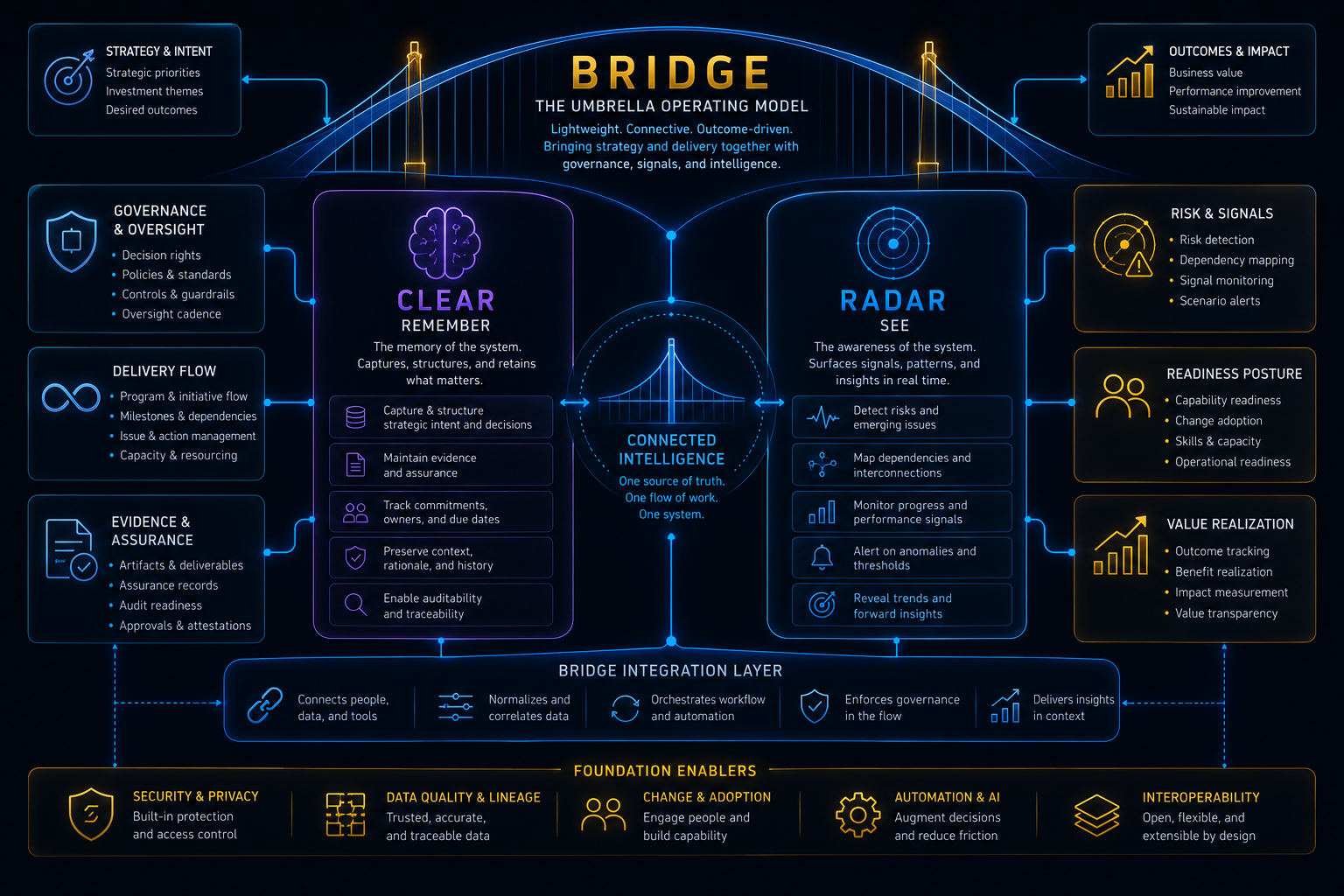
CLEAR helps the system remember. RADAR helps the system see. BRIDGE gives both a place to matter.
The important point is that BRIDGE should remain modular.
No one needs another all-or-nothing transformation model.
Organizations should be able to adopt the pieces that solve real problems:
- intent capture
- readiness visibility
- dependency intelligence
- evidence continuity
- governance routing
- value traceability
- AI-assisted signal extraction
- automation pattern matching
Start where the pain is.
Build from there.
Do not begin by asking teams to bow before a fully formed methodology.
That road leads to laminated posters and quiet resentment.
Why Lightweight Matters
Lightweight does not mean weak.
Lightweight means intentionally designed not to crush the work it is supposed to improve.
This distinction matters because governance and operating model improvement often fail by becoming too heavy.
They ask for too much manual input.
They produce too many artifacts.
They create too many meetings.
They make teams explain work they already did instead of helping the system learn from that work automatically.
A lightweight model should do the opposite.
It should extract more value from signals teams already create.
It should reduce reconstruction.
It should make status conversations sharper.
It should help leaders ask better questions.
It should make governance more evidence-driven.
It should make delivery teams feel less like unpaid data-entry clerks for executive reporting.
That is the promise.
If BRIDGE adds more burden than clarity, it is not a bridge.
It is a toll road.
And nobody needs another toll road through enterprise delivery.
What Good Looks Like
When BRIDGE is working, the enterprise should feel different.
Not magically transformed.
Not free of conflict.
Not suddenly immune to legacy systems, budget pressure, regulatory complexity, or the ancient curse of shared environments.
Different in practical ways.
Leaders can see whether delivery is still connected to intent.
Governance conversations use evidence instead of archaeology.
Dependencies surface earlier.
Readiness becomes easier to explain.
Risk signals show up before release week.
Value does not disappear after funding approval.
AI and automation opportunities are matched to real operating model problems instead of being sprinkled around like innovation confetti.
Teams spend less time recreating truth.
Executives spend less time asking why all the dashboards are green while everyone in the room looks like they just heard a noise from the basement.
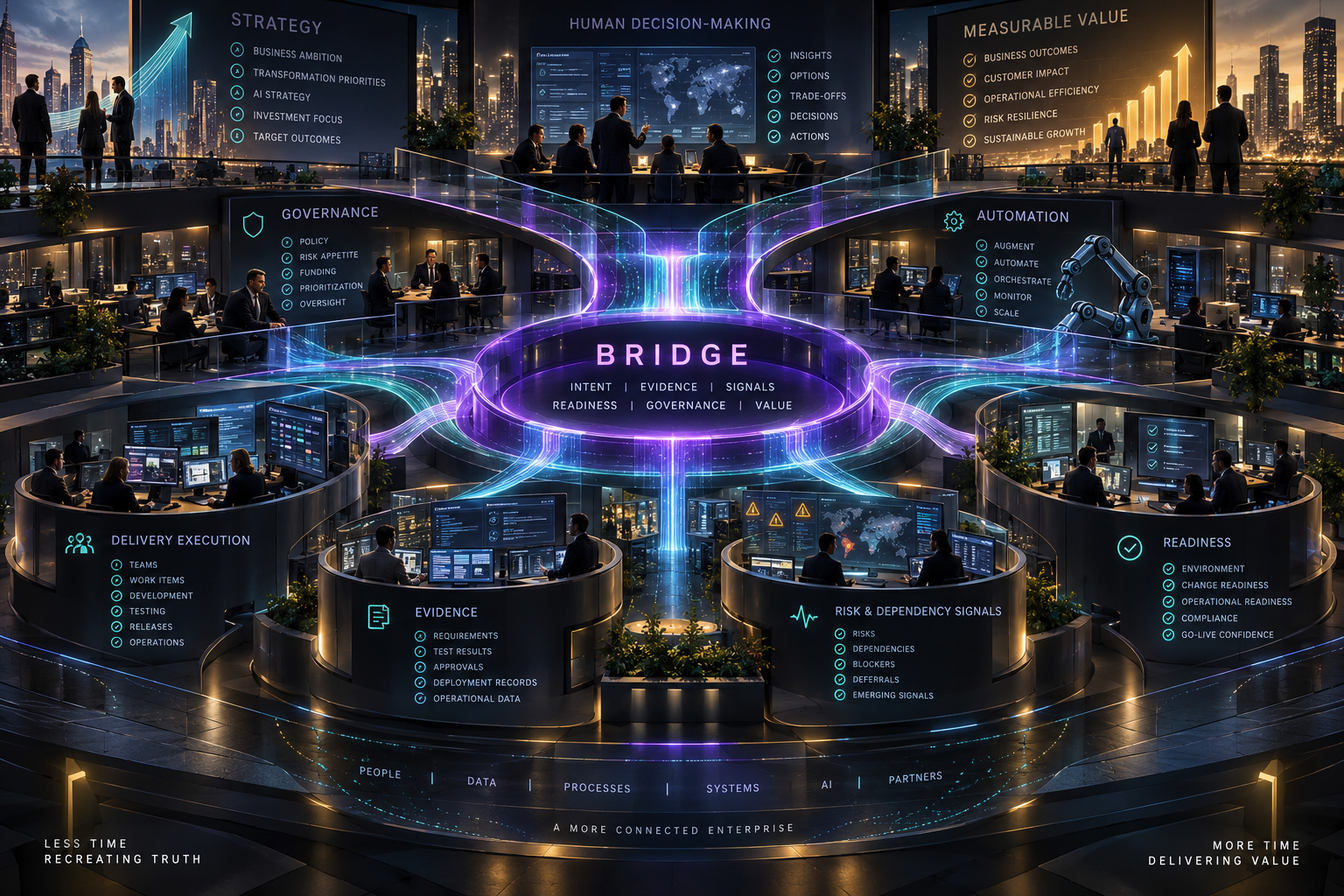
Good operating models do not eliminate complexity. They make complexity easier to see, govern, and move through.
That is what good looks like.
Not perfection.
Connectedness.
Where This Goes Next
This article is the opening statement.
Not the full manual.
Not the white paper.
Not the giant deck.
The point here is simply to name the problem and introduce the idea:
Large enterprises need a better way to connect the messy middle.
BRIDGE is my working answer.
From here, there are several places to go:
- how BRIDGE connects strategy to execution
- how BRIDGE supports AI-forward operating model transitions
- how BRIDGE uses CLEAR to preserve intent and readiness
- how BRIDGE uses RADAR to surface hidden delivery signals
- how BRIDGE can help leaders govern work without building another monolith
- how BRIDGE can support value realization, release confidence, and enterprise decision quality
This is going to stay practical.
No ceremony worship.
No giant process cathedral.
No claims that one model can solve every enterprise headache from platform modernization to the coffee machine being out of oat milk.
Just a serious attempt to solve a serious problem:
The enterprise wants transformation.
The work lives in fragments.
Something has to connect them.
Final Thoughts
The enterprise does not need another framework for the sake of having another framework.
It needs connective tissue.
It needs a way to preserve intent as work moves.
It needs a way to capture evidence before everyone is sweating through release governance.
It needs a way to surface risk signals before they become executive escalations.
It needs a way to trace business value after the funding deck has left the room.
It needs governance that improves confidence without dragging teams into a swamp.
And as AI pushes organizations to redesign work, decision-making, governance, and value realization, the messy middle is only going to matter more.
BRIDGE is not the whole answer.
It is a working answer to a very real problem.
A lightweight operating model for connecting strategy, execution, governance, evidence, signals, and value.
A way to help enterprises move from ambition to action without losing the thread.
Not another monolith.
A bridge.
And yes, that still feels both fixable and worth fixing.
Join the Conversation
Where does strategy lose contact with execution in your organization?
Between funding and delivery?
Between agile teams and governance?
Between AI pilots and operating model change?
Between readiness reporting and actual release confidence?
Between value promises and measurable outcomes?
Or somewhere else entirely?
I would love to hear the real-world version.
Not the transformation-office version.
The actual version from the messy middle, where ambition meets delivery, controls, dependencies, evidence, and the occasional spreadsheet holding together an enterprise process that everyone pretends is mature.
What needs to be connected better?
What should be lighter?
And where would a bridge actually help?
About the Author
Joe Mack is a Technology Consulting Senior Principal specializing in technology leadership, enterprise SDLC transformation, release management, deployment governance, and delivery optimization for household name Financial Services companies. Joe is also a lifelong self-learner and builder of systems, and Free Tier Life is one of the ways he is trying to turn those experiences and instincts into something other people can actually use.
Bibliography
- Deloitte. “Enterprise AI Trends in 2026: AI Transformation Strategy Opportunities and Predictions.” June 2, 2026.
- Deloitte. “Rewiring the Enterprise Operating Model for AI Scale.” June 29, 2026.
- Deloitte. “The State of AI in the Enterprise: Deloitte’s 2026 AI Report Tracking Adoption and Impact.” 2026.
- World Economic Forum, in collaboration with Accenture. “The AI Playbook for Financial Services.” June 2026.