Everything Broke In the Last Week. Your Disaster Recovery Plan Isn’t the Point.

Published on Nov 20, 2026
Everything Broke In the Last Week.
Your Disaster Recovery Plan Isn’t the Point.
The outages were mostly unrelated. That is exactly why executives should care.
For a few days in November, enterprise technology appeared to be auditioning for a disaster movie.
Microsoft 365 stumbled. Workday went unavailable for affected customers. The FAA grounded departures nationwide. AWS had authentication and connectivity problems in us-east-1. Banking and airline systems had their own bad days, too.
Naturally, the internet tried to turn the whole thing into one giant, coordinated cyberattack.
There is no credible evidence of that.
Good. Because the less cinematic explanation is more useful.
A bunch of sophisticated organizations experienced separate failures for different reasons, and ordinary business capabilities disappeared anyway.
That is the part executives should sit with.
Microsoft said its outage was technical, not cyber or AI-related. Reuters reported that the disruption lasted more than a day and affected Outlook, Teams and other Microsoft services used by businesses and governments around the world.
The FAA says data flooding its telecommunications network created instability in aircraft communications and radar feeds, prompting a precautionary nationwide ground stop that remained in place for more than four hours.
An AWS Health Dashboard incident record reported authentication and connectivity problems in us-east-1, including IAM Identity Center.
Workday customers lost access to HR, payroll, time-reporting and other workflows after a problem involving its disaster-recovery environment.Different systems. Different failure modes. Different owners.
Same executive question:
What can our company no longer do when somebody else’s technology has a bad day?
That question is bigger than disaster recovery.
It is the beginning of a proper discussion about resilience.
The outage may be owned outside of your company. The consequences of the outage are still owned by YOU.
Stop Recovering Systems. Start Protecting Capabilities.
Technology organizations have spent decades getting better at recovery.
- Recovery time objectives.
- Recovery point objectives.
- Redundant infrastructure.
- Availability zones.
- Secondary regions.
- Backups.
- Runbooks.
- Incident bridges.
- Vendor SLAs.
- Business continuity plans.
- Disaster-recovery exercises.
Those are all useful.
But they are not enough.
Your business, and your customers, do not consume RTOs.
They consume capabilities.
A customer needs to place an order. A warehouse needs to ship it. An employee needs to get paid. A trader needs to transact. A pilot needs safe operational information. A claims adjuster needs to serve a policyholder. A sales team needs to communicate with a customer.
When technology fails, that is the basic unit of consequence.
This is where a surprising number of resilience programs lose altitude. They can tell you how quickly a database should recover, how often a virtual machine is replicated, or what availability a vendor contract promises.
However, when you ask whether the business can still execute its five most important services when identity, communications, payments, a SaaS control plane, a network dependency, and one critical third party fail in an inconvenient combination, the confidence level sometimes changes. Seldom for the better.
That is not because disaster recovery is useless.
This happens because system recovery is a single component of business resilience, not its entire definition.
NIST has made the relationship explicit for years: information-system contingency planning has to connect with organizational resilience, security, emergency management, and operational priorities. The tooling has changed considerably since that guidance was written. The executive problem has not.Your Most Dangerous Dependency Might Be the Boring One
The November incidents are useful precisely because they refuse to fit one clean story.
Microsoft’s outage showed how a defect inside shared infrastructure could propagate into services that sit in the middle of how things get done in the modern workday.
AWS’s us-east-1 event affected IAM Identity Center sign-in and services that depended on it. That should trigger a particularly uncomfortable question for technology leaders:
Can the people responsible for recovering our environment still get into the environment when the identity path is impaired?
That is the kind of dependency that looks boring on an architecture diagram right up until it becomes the single showstopper in the middle of recovery.
The FAA example is even more visceral. The agency reports that legacy equipment became unstable after its network was flooded with connection attempts, affecting communications and radar feeds. The response was not to keep flying and admire the redundancy diagram. The FAA stopped departures nationwide out of caution while the network was stabilized.
That was a technology incident.
The consequence was an aviation-system decision for an entire nation.
And Workday offers perhaps the most deliciously uncomfortable resilience lesson of the bunch: public reporting tied the disruption to disaster-recovery validation, with services in a recovery environment unexpectedly connecting to production databases and leaving data inconsistent.
Read that again.
The thing intended to help recover from failure participated in the failure, and made it worse.
If that sentence does not make you want to revisit how your organization tests recovery, I admire your confidence. Delusion, perhaps, but admirable nonetheless.
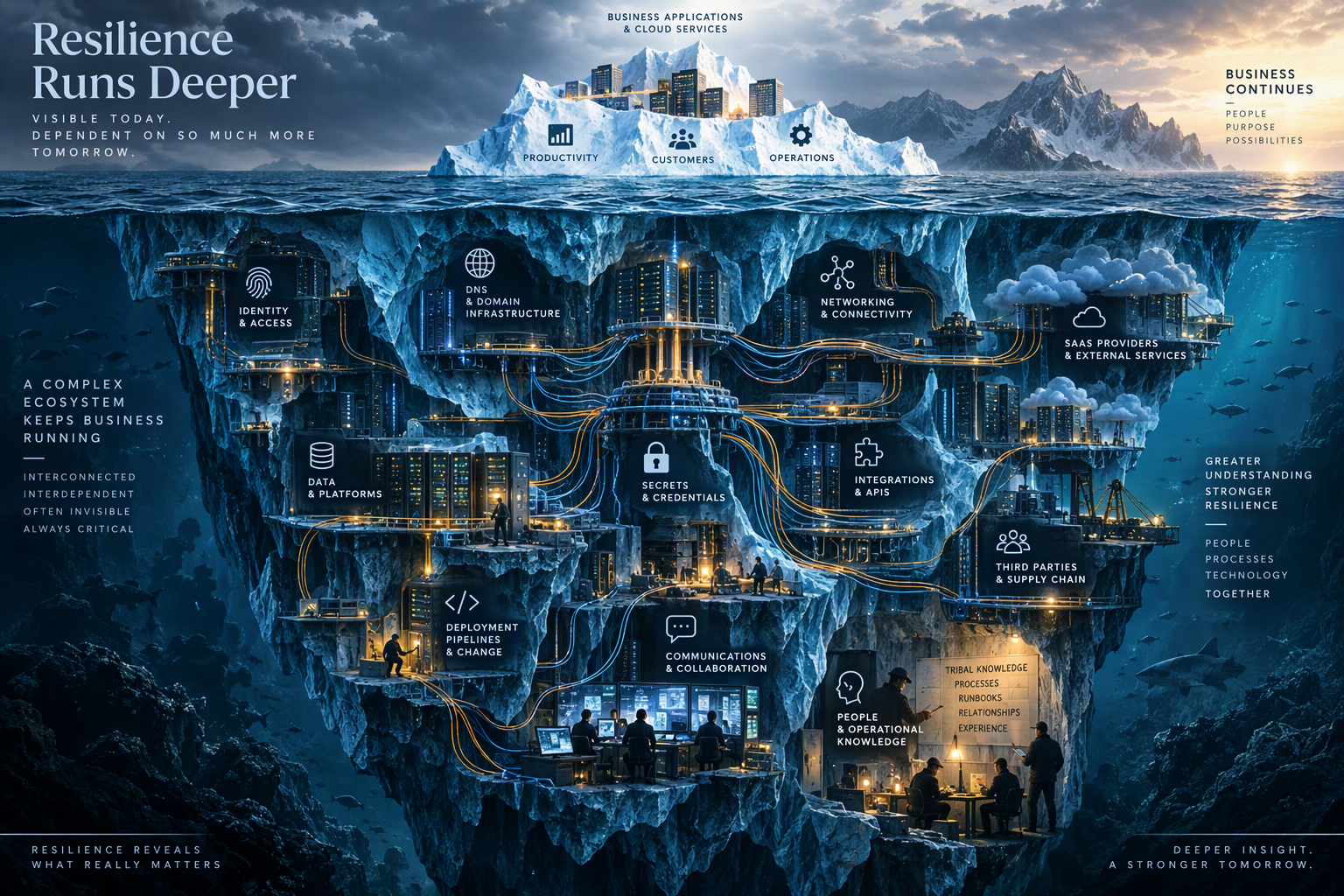
The application is usually the easy dependency to see. Sometimes, the truly dangerous dependencies are hidden beneath it.
Redundancy Can Be “High Availability” Theater
There is a comforting version of resilience where every critical component has a backup.
Two data centers. Two network paths. Multiple availability zones. Redundant identity services. Secondary environments. A second vendor tucked into a procurement deck somewhere.
Excellent. Those are table stakes these days.
Now ask whether the supposedly independent paths share:
- the same identity provider;
- the same DNS or network control plane;
- the same cloud region;
- the same management plane;
- the same integration platform;
- the same secrets store;
- the same deployment pipeline;
- the same human approval path;
- the same upstream SaaS provider;
- the same operating team;
- or the same bad assumption.
Two copies of the same dependency are not necessarily two independent paths.
Sometimes they are just the same failure lying in wait, ready to ambush you from two different places.
That distinction belongs at executive altitude because concentration risk is increasingly hidden behind abstraction.
The enterprise buys SaaS to avoid running software. It buys cloud to avoid owning infrastructure. It federates identity to simplify access. It centralizes integration to reduce duplication. It standardizes communications, observability, secrets, deployment and data platforms because standardization usually makes economic and operational sense.
Then resilience shows up with the invoice.
Every act of simplification can create concentration.
That does not mean “decentralize everything.” That would replace correlated fragility with expensive chaos. No one wants that.
It means concentration has to be visible, intentional, and priced into the operating model.
Your Vendor’s Resilience Is Not Your Resilience
Here is one of my least favorite answers to any resilience question:
Our vendor assures us they have redundancy.
Wonderful.
Can your business operate when the vendor’s system is down?
A vendor can hit its contractual recovery target while your business misses its customer commitment.
A cloud provider can restore the service while your backlog, interfaces and manual workarounds take another day to unwind.
A SaaS platform can be technically available while your identity path remains broken.
A critical supplier can have three regions while your implementation uses one.
Your provider owns their architecture.
You own the business dependency you created on top of it.
That ownership should change third-party conversations. Procurement should not stop at uptime percentages and service credits. An SLA credit is useful commercial hygiene. It is a terrible continuity strategy.
The executive questions are different:
- What business service depends on this provider?
- What happens after 30 minutes, four hours, one day and three days without it?
- What is the degraded operating mode?
- Which transactions can wait?
- Which cannot?
- What data must remain accessible independently?
- What identity or communications path survives the vendor?
- Who can authorize an exception?
- How do we reconcile work performed during the outage after service returns?
That last question never gets enough love.
Restoration is not the same as recovery.
If service returns at 10:00 a.m. but it takes until next Tuesday to untangle duplicate transactions, replay integrations, reconcile queues and tell customers what actually happened, the system has recovered long before the business has.
The Worst Normal Day
Traditional resilience planning loves catastrophes.
Flood. Fire. Cyberattack. Data-center loss. Regional cloud failure.
Those scenarios deserve planning.
But I increasingly like a less theatrical test:
What happens on our worst normal day?
Not the asteroid.
A bad deployment. An expired certificate. A routing problem. An identity provider that cannot authenticate responders. A SaaS platform in maintenance mode. A cloud service degradation. A human making a reasonable change that interacts with something nobody knew was coupled to it.
You know, just some random Tuesday headaches.
The 2026 Verizon Data Breach Investigations Report is a cybersecurity report, not an availability study, but its larger message is useful here: threat sophistication keeps increasing while fundamentals still matter. Resilience has the same problem. Enterprises can spend enormous energy modeling exotic failure while ordinary change, dependency and human error remain perfectly capable of producing an extraordinary business consequence.
A separate tracker covering major AWS, Azure, Google Cloud and Cloudflare outages since 2020 found configuration or deployment changes were the most common cause in its dataset, and software bugs or automation represented another large share. That is not an argument against change.
It is an argument for recognizing that change velocity is part of the resilience model.
The company that never changes may avoid change-induced outages.
It will eventually enjoy a much larger strategic outage.

Resilience is not the absence of failure. It is the ability to keep making good decisions while failure is happening.
Resilience Is a Decision System
This is the part I think gets missed or ignored most often.
Architecture matters.
Redundancy matters.
Testing matters.
But resilience is also a decision system under pressure.
When the normal path disappears:
Who can declare degraded operations?
Who can bypass a control, and under what conditions?
Who decides whether to queue transactions or reject them?
Who can move communications to an alternate channel?
Who tells customers what we know before certainty arrives?
Who decides that recovery is causing more risk than waiting?
Who owns the business backlog after the technology is restored?
Who has authority when the normal approver cannot authenticate?
A technically elegant failover that requires an unavailable executive approval is not resilient.
A break-glass account nobody has tested is not resilient.
A manual workaround that only one employee remembers is not resilient.
A recovery plan sitting inside the platform currently unavailable is comedy.
Maybe dark comedy. Still comedy.
The point is not to eliminate failure.
You cannot.
The point is to preserve enough capability, information, and authority to enable good decisions while the failure is happening.
Five Questions I Would Immediately Ask After a Week Like This
If I were walking into an executive technology review after the past week, I would not begin by asking whether our disaster-recovery tests passed.
I would ask these instead.
1. What are the five business capabilities we cannot afford to lose?
Not applications. Not servers. Not platforms.
What must customers, employees, partners or operators still be able to do?
2. Which hidden dependency can take out more than one of them?
Identity. Network. Cloud region. Integration. SaaS. DNS. Payments. Data. Communications. A key supplier. A person.
Show me concentration, not component inventory.
3. Can we operate badly on purpose?
Graceful degradation is underrated.
If the perfect process is unavailable, what reduced service can we safely provide? For how long? With what controls? Who has the authority to activate it?
A company that can only operate perfectly or not at all has made perfection a single point of failure.
4. When did we test the whole business path?
Not the database restore.
Not the failover button.
The chain from customer need through identity, application, integration, data, third parties, people, decision rights, and reconciliation.
If each component passed independently, congratulations. You have evidence that each component passed independently.
5. How do we know the business has recovered?
Not when the vendor status page turns green.
When orders flow. Employees get paid. Customers can reach us. Backlogs are reconciled. Deferred work is processed. Controls are restored. Exceptions are closed. The business service is healthy again.
That is the finish line.
The Board Does Not Need the Incident Timeline
Boards should absolutely understand material technology risk.
They do not need to become incident commanders.
After a significant outage, the board’s job is not to debate router configuration or ask for every timestamp from the bridge.
The board should ask whether management learned something structural:
- Did the incident reveal concentration we did not understand?
- Did a supposedly independent recovery path share the original failure domain?
- Did management know which business capabilities would fail first?
- Were decision rights clear under degraded conditions?
- Did third-party dependencies behave the way our risk assumptions said they would?
- Did recovery restore the business or merely the technology?
- What investment or architectural decision changes now that we know this?
That last question is hugely important.
Postmortems are easy to admire and, surprisingly, even easier to ignore.
If the incident teaches the organization something material, but no capital, architecture, contract, operating process or decision right changes afterward, the lesson was recorded, not learned.
Availability Is Not the Point
There will be another outage.
It may involve a cloud provider, communications platform, identity service, payroll system, payment network, network device, software deployment, security control, human mistake, or something we have not yet invented a dashboard for.
The executive objective cannot be to make technology incapable of failing.
That sounds like a clear path to infinite cost and guaranteed disappointment.
The actual objective is to make the enterprise capable of continuing to make responsible business decisions when technology does fail.
That changes what you map out.
It changes what you test.
It changes what your board asks.
It changes what your vendors have to prove in order to keep your business.
It changes how much concentration you are willing to accept in exchange for efficiency.
And it changes your definition of recovery from:
The system is back online.
To:
We can deliver our critical business capabilities again.
Last week was not one giant outage.
That is the point.
It was a reminder that resilient enterprises do not merely recover machines, applications and clouds.
They preserve the ability to operate through the failures they did not get to choose.
Stay in the Messy Middle
Technology strategy gets interesting where the pretty, clean diagrams stop working: competing priorities, old systems, new promises, finite budgets, human judgment, and the occasional week when half the internet appears to need a reboot.
FreeTierLife is where I write about operating in that space without pretending complexity can be wished away.
If that is your kind of conversation, subscribe to the newsletter using the form below.
About the Author
Joe Mack is a technology strategy and transformation executive who helps organizations turn technology investment into measurable business value. His work sits at the intersection of business strategy, technology, operations, and economics, with a focus on making smart investment decisions, simplifying complexity, modernizing responsibly, and building technology organizations that can execute. Through FreeTierLife, he writes about pragmatic AI and automation, technology leadership, governance, operating models, and the messy work of turning executive intent into realized value.
Bibliography
- Reuters: Microsoft restores service to Outlook and Teams after global outage
- Federal Aviation Administration: Nationwide Ground Stop Questions and Answers
- AWS Health Dashboard mirror: November 15 us-east-1 incident timeline
- Ally Incident Briefings: Workday production service outage
- NIST SP 800-34 Rev. 1: Contingency Planning Guide for Federal Information Systems
- Verizon: 2026 Data Breach Investigations Report
- Control Plane: Major cloud outage tracker and cause analysis