Early-career consultants are usually told to keep learning and take on
harder work. Useful advice, but incomplete. Growth also means learning
how to operate as a professional and earning enough trust to help shape
the outcome, not merely produce the deliverable.
Learn the craft.→Practice the profession.→Earn the trust.
The framework at a glance
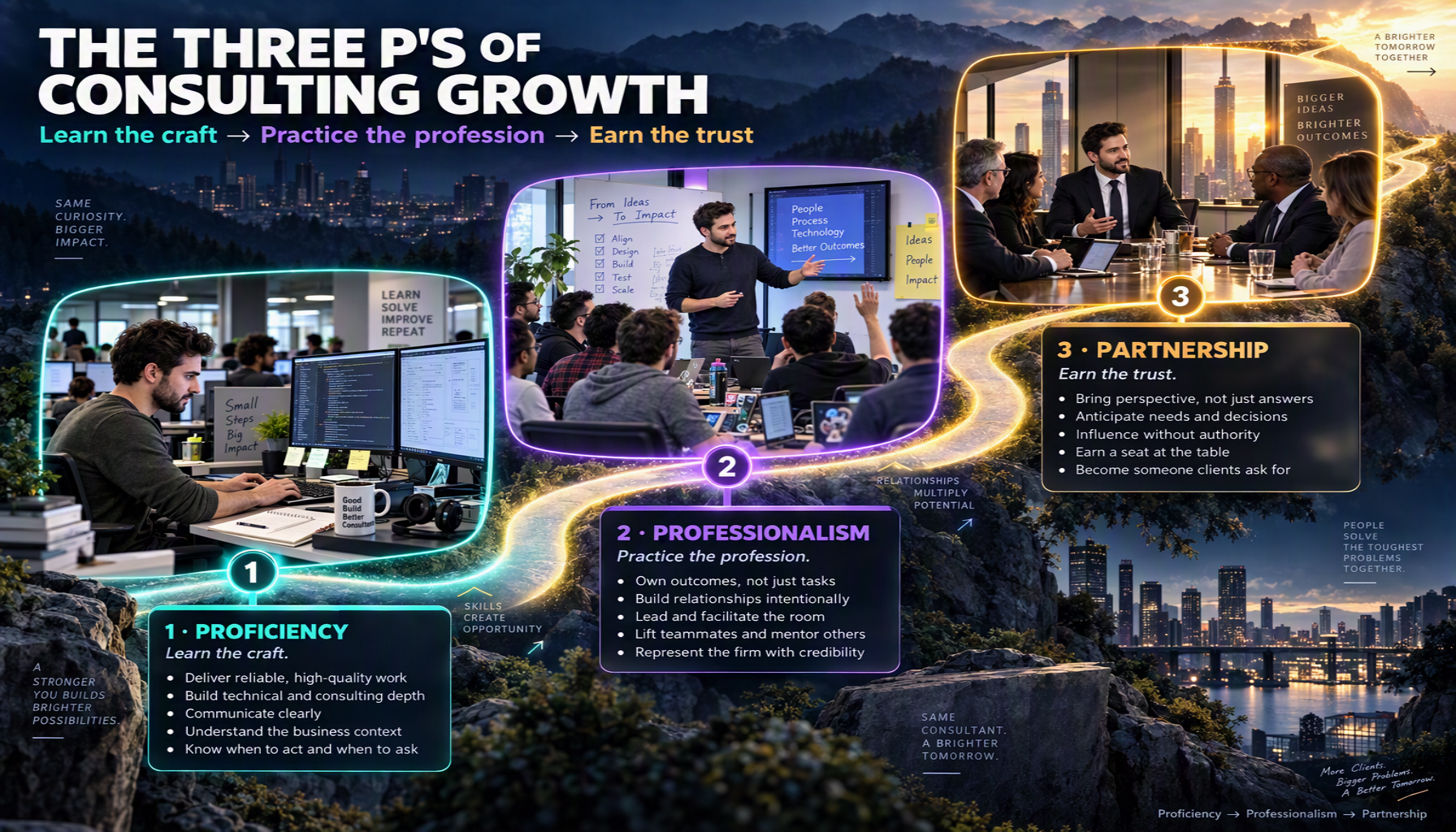
The Three P's One-Pager
A portable visual summary of Proficiency, Professionalism, and
Partnership.
The Three P's are dimensions of growth, not three promotions wearing
fake mustaches. Partnership does not replace Professionalism, and
Professionalism does not excuse shaky Proficiency. You keep the
foundation while widening your impact.
Foundation
Proficiency
Learn the craft
Build the skills and judgment to produce reliable, high-quality
work.
Technical and functional capability
Consulting methods and delivery discipline
Clear communication
Business and client context
Self-sufficiency with sound escalation
→
Expansion
Professionalism
Practice the profession
Show up as a consultant, teammate, and representative of the firm.
Intentional relationships
Ownership beyond assigned tasks
Leadership and team contribution
Presence, reliability, and judgment
Firm and community contribution
→
Influence
Partnership
Earn the trust
Become someone colleagues and clients seek out for judgment and
perspective.
Credibility with stakeholders
Anticipation of needs
Perspective beyond the immediate ask
Influence without authority
Shared ownership of outcomes
The simplest version: Do strong work. Learn how to operate. Earn the trust to shape what
happens next.
Design principles
Evidence over adjectives
“Strong communicator” is fog. Name the situation, what the person
actually did, and what changed because of it.
Development over labeling
Use the model to identify the next move, not stamp somebody with
a permanent label.
Patterns over hero moments
One spectacular save proves somebody had a good day. Repeated
behavior across different situations shows growth.
Context over comparison
Assess the consultant against role expectations, opportunity, and
trajectory, not somebody else's highlight reel.
Impact over activity
Busy is not a result. Connect the work to quality, speed,
confidence, team health, or client value.
Mutual accountability
The consultant owes the effort. Leadership owes the opportunity,
context, coaching, air cover, and candor.
1
Proficiency
Learn the craft. Can you do the work well, explain it clearly, and exercise judgment while doing it?
This is where a capable practitioner starts operating like a consulting
professional.
Observable behaviors
Owns commitments, closes loops, and communicates before surprises become problems.
Builds relationships beyond the people needed for today’s task.
Adapts communication to teammates, leaders, and client stakeholders.
Creates clarity, coordinates others, and leads a bounded piece of work.
Helps teammates succeed and supports newer colleagues.
Contributes to reusable assets, communities, recruiting, learning, or capability building.
Represents the firm with care, judgment, and credibility.
Common stall pattern
Excellent individual output, but weak follow-through, narrow relationships, invisible risk, or a habit of treating “my task is done” as the finish line.
Growth question
“How did your presence make the team, client, or firm stronger beyond the artifact you delivered?”
3
Partnership
Earn the trust. Nobody gets to self-certify as a trusted advisor. Other people decide whether to trust your judgment.
Partnership shows up when people bring the consultant in earlier, ask
for judgment, share the messy parts, and trust them in consequential
conversations.
Observable behaviors
Understands the problem behind the request instead of blindly servicing the request.
Brings a point of view grounded in client context and delivery reality.
Anticipates stakeholder needs, decision points, and downstream consequences.
Connects people, ideas, and capabilities across organizational boundaries.
Challenges constructively without becoming performative or adversarial.
Balances client advocacy, team health, delivery integrity, and firm responsibilities.
Is requested by name, invited earlier, or trusted with broader scope.
Common stall pattern
Mistaking visibility for trust, confidence for judgment, or agreeable client service for genuine partnership.
Growth question
“Where are people now seeking your judgment, and what did you repeatedly do to earn that trust?”
Maturity model
Use four maturity states inside each P. A consultant can sit at different
states across the three dimensions. That asymmetry is the point: it makes
feedback specific.
Level 1 Learning
Needs examples, structure, and frequent coaching. Applies behaviors
inconsistently or in familiar situations only.
Level 2 Applying
Demonstrates the behavior in normal conditions with periodic
support. Reliability is forming.
Level 3 Owning
Demonstrates the behavior independently across contexts and helps
create clarity for others.
Level 4 Multiplying
Raises the capability of the team, creates reusable patterns, and
helps others adopt the behavior.
Dimension
Learning
Applying
Owning
Multiplying
Proficiency
Builds fundamentals; needs review and examples.
Produces sound work in familiar situations.
Handles complex work independently and explains trade-offs.
Creates standards, teaches others, and improves the delivery
system.
Professionalism
Learns team norms and basic consulting habits.
Follows through, communicates reliably, and contributes beyond
tasks.
Leads bounded scope, strengthens relationships, and develops
others.
Shapes team culture, creates opportunities, and raises the
standard of practice.
Partnership
Builds credibility through preparation and listening.
Offers useful perspective and develops stakeholder trust.
Is sought out for judgment and helps shape decisions.
Creates networks of trust and enables broader client and firm
outcomes.
Important: Maturity is contextual. “Owning” in a familiar workstream can coexist
with “Learning” in a new industry, client environment, or technical
domain.
Development toolkit
Development moves faster when learning is tied to exposure, practice,
timely feedback, and honest reflection.
🎯 One-step stretch
Choose assignments one meaningful step beyond current independence:
facilitate part of a workshop, own a client readout, coordinate a
small workstream, or mentor a new joiner.
👀 Observe → debrief → retry
Shadow a strong practitioner, discuss what they noticed and chose,
then repeat a similar situation with the consultant in the lead.
📓 Evidence journal
Capture situation, behavior, impact, feedback, and next experiment
weekly. This prevents the annual ritual of trying to reconstruct
twelve months of work from calendar fragments and old messages.
🧭 Stakeholder map
Track who matters, what they value, current trust, interaction
cadence, and one useful contribution the consultant can make.
🧪 Behavior experiments
Turn vague goals into two-week tests: summarize decisions in writing,
bring two options with a recommendation, or ask one business-context
question per meeting.
🔁 Feedforward
Before the next consequential moment, agree on one behavior to try
and what visible success would look like.
Questions for the consultant
What do you want to be trusted with next?
What work are you still completing mechanically rather than
understanding?
Where are you creating leverage for someone else?
Whose perspective do you need to understand better?
What evidence would show meaningful growth by the next checkpoint?
Actions for the leader
Make expectations observable and explain why they matter.
Create access to meetings, decisions, and context, not just more
tasks.
Delegate outcomes with boundaries, authority, and air cover.
Give feedback close to the moment and recognize progress publicly
when appropriate.
Separate a safe learning miss from careless repeat behavior.
Reusable feedback framework
Make each P a short evidence-based narrative. The goal is a fair account
of demonstrated impact, current maturity, and the next practical growth
move.
1. Evidence
Name the situation and directly observable behavior. Avoid
personality labels and unsupported generalizations.
“During the design workshops, you…”
2. Impact
Explain what changed for quality, speed, confidence,
decision-making, team effectiveness, or client outcomes.
“This enabled the team to…”
3. Next move
Identify one behavior to repeat, stretch, or change, plus a
concrete opportunity to practice it.
“The next step is to…”
Core pattern: “You demonstrated behavior in context, creating impact. This shows maturity in P. To expand
your impact, practice next behavior through specific opportunity.”
Balanced year-end structure
Overall trajectory: one concise statement of growth and impact.
Proficiency: strongest capabilities, evidence, and next depth target.
Professionalism: how they show up, broaden ownership, and strengthen others.
Partnership: evidence of growing trust and the next relationship or influence
move.
Forward commitment: the leader's opportunity, sponsorship, and coaching promise.
Language swaps
Replace “needs more confidence” with the specific behavior
confidence should unlock.
Replace “be more strategic” with the decision horizon, context,
and trade-offs to consider.
Replace “increase visibility” with the audience, contribution,
and forum that matters.
Replace “show leadership” with the outcome to own and the people
to enable.
Replace “great attitude” with the behavior and effect on the team.
Operating cadence
Weekly: capture
Record one piece of evidence, one lesson, and one next experiment.
Keep it lightweight and factual.
Monthly: calibrate
Pick one development focus. A twelve-item self-improvement buffet
is how all twelve items survive untouched.
Quarterly: broaden
Review opportunity, exposure, relationships, and scope. Leaders
cannot demand growth while withholding the opportunities needed to
practice it.
Quick development pulse
Check the statements that are consistently true. This is a conversation aid,
not a score or rating.
0/8signals consistently observed
Guardrails and failure modes
Avoid
Treating the framework as a hidden rating scale.
Confusing extroversion, polish, or executive mimicry with
Professionalism.
Rewarding heroics caused by poor planning.
Expecting Partnership without providing client access or context.
Using “trusted advisor” as a vague compliment without evidence.
Penalizing somebody for invisible expectations that were never
communicated.
Equating additional responsibilities with endless unpaid or
unrecognized labor.
Protect
Role clarity and explicit standards.
Psychological safety for questions, challenge, and learning.
Fair access to stretch work, visibility, sponsorship, and
feedback.
Recognition of team enablement, not only individual artifacts.
Boundaries, sustainable performance, and responsible escalation.
Room for different credible leadership and communication styles.
The distinction between developmental feedback and formal firm
policy.
Leadership contract: The consultant owns preparation, practice, follow-through, and
reflection. The leader owns clarity, opportunity, context, feedback,
sponsorship, and air cover. Growth is a shared delivery commitment.