
When Using AI for Everything Becomes Irresponsible

Published on Oct 26, 2026
When Using AI for Everything Becomes Irresponsible
AI should have to earn its place in the architecture

If a switch will do the job, do not commission a reasoning engine and call the extra machinery “transformation”.
There is a point where enthusiasm becomes negligence.
Enterprise AI is getting dangerously close to it.
Let me get the disclaimer out of the way before somebody mistakes this for a man tilting at windmills. I am bullish on AI. Aggressively bullish. I spend an inordinate amount of time thinking about how generative and agentic AI systems can change software delivery, program intelligence, operations, governance, and knowledge work.
That is precisely why I want us to stop reaching for AI as a panacea.
Using AI where it creates material value is innovation. Using AI everywhere because the strategy deck says “AI-first,” or out of a fear of missing out, is allowing your system architecture to be influenced by peer pressure and cult leader language.
And once the technology starts making decisions, taking actions, touching customer data, producing regulated work products, or quietly eating through variable consumption charges, the distinction stops being academic.
Rather, the distinction immediately becomes:
- fiscal discipline.
- operational risk mitigation.
- governance.
- responsibility.
The Cheapest Adult in the Room
I have argued this before in The $10 Script vs. the $10,000 Agent and Stop Throwing Agents at Problems a Script Could Solve. Failing to use the full automation continuum is just plain failing.
First things first: the automation continuum is not a maturity ladder.
It is a routing discipline.
A healthy continuum looks something like this:
Manual judgment → scripts → rules → workflow/RPA → analytics/ML → generative AI → agentic AI
The goal is not to shove work to the right.
The goal is to work your way left-to-right, asking questions, and stop at the least complex mechanism that can safely, reliably, and economically produce the required outcome.
That sentence will not get nearly as much stage time at a technology conference as “multi-agent orchestration.” It will, however, save somebody money. Lots of it.
If the rule is knowable, encode it.
If the workflow is deterministic, automate it.
If you need synthesis over language, generative AI may earn the job.
If the problem genuinely requires planning, ambiguity resolution, tool use, adaptive reasoning, or delegated autonomy, then an agent may earn the job.
May.
That word is doing some work.
“Because an agent can do it” is quick, and potentially dirty. Oh, so very dirty. Also, it’s not a business case.
“Because an agent earned it” is something that even the bean counters can get behind. A helicopter can get you across town faster than your car. Most commutes simply don’t justify paying for a helicopter.
AI Has a Risk Surface. Pretending Otherwise Is Not Bold.
The National Institute of Standards and Technology’s Generative AI Profile exists because generative AI creates risks organizations have to identify and manage across the AI lifecycle. NIST frames responsible AI around governance, measurement, management, and trustworthiness rather than around enthusiastic deployment. source
That should not be controversial.
Every time we move a workload from deterministic software into probabilistic behavior, we should be able to explain what we bought with that upgrade.
Not in vibes.
In value.
Did we improve quality? Increase throughput? Handle ambiguity that ordinary automation could not? Reduce cycle time enough to matter? Create a capability that was previously missing? Free humans from work that genuinely required language understanding or reasoning?
Great. Keep going.
If the answer is basically, “The demo looked cooler with AI in it,” pump the damn brakes.

A proof of concept proves possibility. It does not magically prove production readiness, economics, control effectiveness, or adult supervision whatsoever.
A POC Is Not a Diplomatic Passport
This is the transition where enterprises get themselves into trouble.
A proof of concept answers some useful questions. Can the idea work? Can the model interact with the data? Can we get enough signal to justify further investment?
Good.
What it does not answer automatically is:
- whether the capability should operate at scale
- whether it is secure enough
- whether the economics survive real usage
- whether somebody owns the failure modes
- whether the output can be audited
- whether the model is observable, or
- whether a human can stop the thing when it wanders off the sidewalk
The World Economic Forum and Accenture’s 2025 responsible-AI playbook explicitly separates strategy and value creation, governance and accountability, and development and use. Its recommended practices include systematic risk management, transparency into incident response, responsible design by default, and technology enablement for responsible AI at scale. source
That is what the trip from demo to production actually looks like.
Not:
It worked three times in a conference room. Ship it.
Before promotion, I want boring questions answered:
- What business outcome are we buying?
- Why is AI the lowest sufficient level on the automation continuum?
- What data can it see?
- What systems can it touch?
- What actions can it take?
- Where does human judgment remain mandatory?
- What failure modes were tested?
- How will output quality be measured?
- What telemetry and audit evidence exist?
- What happens when the model, prompt, data, or surrounding system changes?
- Who owns the incident?
- Who can stop it?
- At what cost does the business case stop working?
If those questions feel like friction, it is by design. Depending on your answers, some friction might be exactly what you need.
We Already Have Receipts
This is not hypothetical pearl-clutching from people who hate innovation.
In Moffatt v. Air Canada, a customer relied on incorrect bereavement-fare information supplied by the airline’s website chatbot. The British Columbia Civil Resolution Tribunal found Air Canada liable for negligent misrepresentation. The tribunal rejected the idea that the chatbot somehow lived outside the company’s responsibility. source
That case should be printed on a small card and handed to anyone who says, “The AI said it, not us.”
No, champ.
You deployed it.
Then there is the professional-services version of the same lesson. In 2025, Deloitte Australia agreed to make a partial refund on a AU$440,000 Australian government report after a review found incorrect references and a fabricated Federal Court quotation. The revised report disclosed use of Azure OpenAI, while the department said the substance and recommendations remained unchanged. source
That is the kind of story that should end the sentence “but a human reviewed it” as though those five words constitute a control framework.
Human review works only when the reviewer has the time, competence, evidence, and explicit responsibility to catch the failure.
“Human in the loop” is not governance if the human is ornamental.
McDonald’s offers a entirely different flavor of lesson. The company ended its IBM automated drive-through order-taking test in 2024 after piloting it in more than 100 U.S. restaurants, then continued exploring AI through other approaches. The useful lesson is not “AI failed at hamburgers.” It is that a pilot is allowed to teach you that a particular implementation is not ready for the next stage. source
Killing, redesigning, or rerouting an AI use case is not failure.
Scaling one because everybody is emotionally invested in the demo might be.
The Cost Nobody Ever Puts in the Demo
Here is another reason AI pragmatism needs to become an executive discipline: the unit economics can change underneath adoption.
Anyone who has watched enterprise software for longer than eleven minutes knows the pattern. The first conversation is about capability. The second is about adoption. Somewhere later, after usage becomes real, finance discovers that the word “included” should have had several footnotes and “consumption” is a noun with teeth. Big, gnarly, violent teeth.
I recently watched a large enterprise tighten the cost-allocation model around premium AI tooling. A centrally funded entry allocation remained, but usage beyond defined allowances required a valid project charge code so consumption could follow the work creating it.
I am deliberately leaving the employer, product names, and internal pricing mechanics out of a public article. The lesson does not need confidential plumbing to survive:
AI consumption is not magic fairy dust. Somebody eventually gets the invoice.
And that changes architecture.
A pilot used by twelve enthusiasts is not the economic model for a capability used by twelve thousand employees, or worse yet, customers. Neither is a ten-prompt demo representative of an agent running hundreds of tool calls, retries, retrieval operations, evaluations, and monitoring events in production.
Cost governance belongs in the design, not in the autopsy.
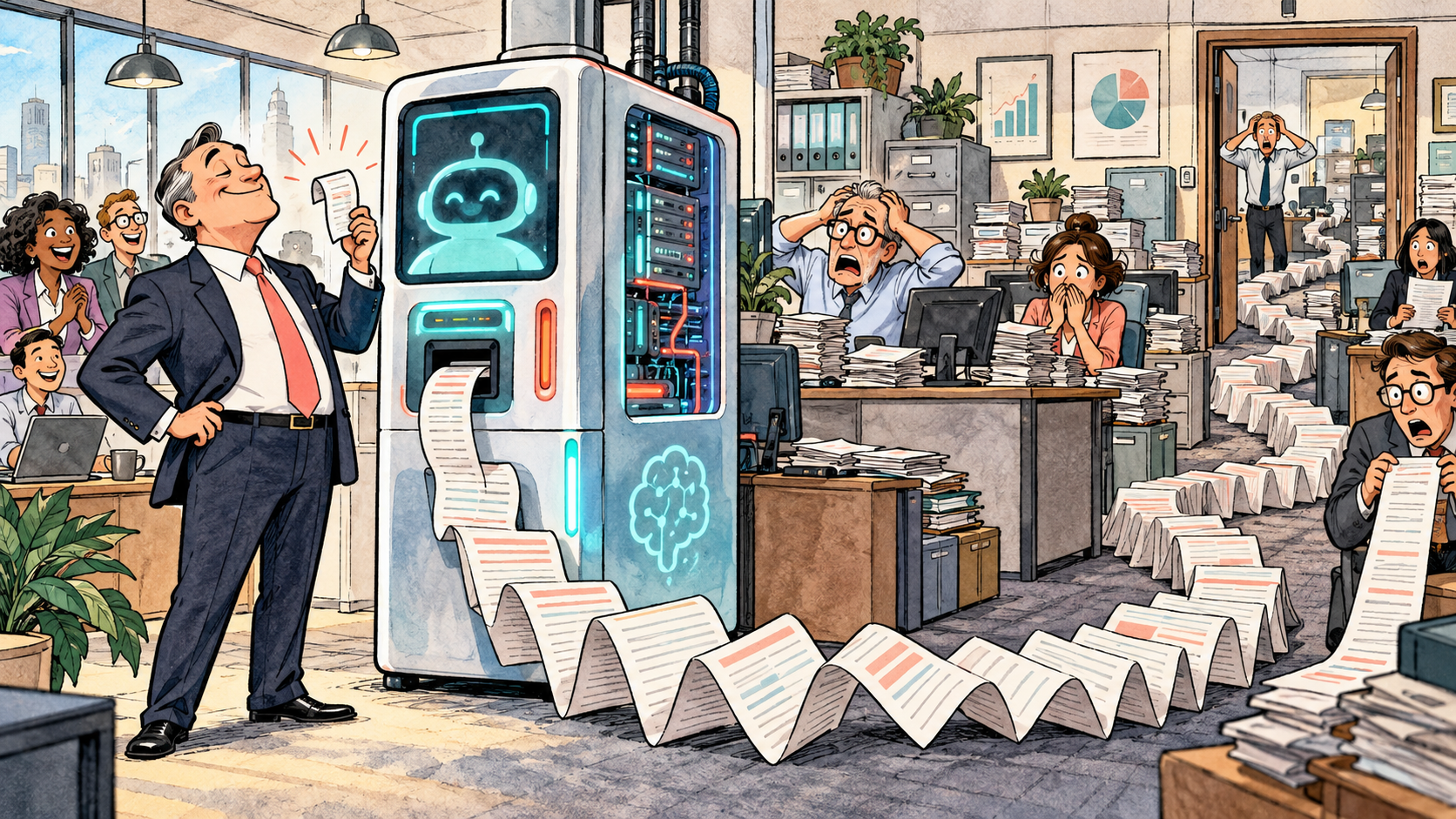
The sticker price is not the operating model. Consumption has a habit of introducing itself after adoption.
Minimum Sufficient Intelligence
So here is the rule I want technology leaders to adopt:
Use the minimum sufficient intelligence required to produce the outcome safely, reliably, and economically.
That is AI pragmatism.
Not anti-AI.
Not timid AI.
Not “wait until somebody else figures it out” AI.
It is the exact opposite. It is how you create room to move faster on the workloads where AI genuinely matters because you are not wasting money, governance capacity, engineering attention, and risk appetite on workloads a rules engine could have handled before lunch.
The automation continuum gives us the routing logic.
Deterministic automation when the rules are knowable.
Generative AI when language and synthesis create meaningful value.
Agentic AI when ambiguity, reasoning, planning, and adaptive action justify autonomy.
And humans where judgment, accountability, ethics, negotiation, empathy, or consequence still make humans the right mechanism.
There is no trophy for reaching the far-right side of the continuum.
The trophy is the business outcome, and, crucially, business value. Overspending for the correct outcome is a huge asterisk, every time.
Governance Is What Lets the Good Stuff Escape the Lab
This is the part where governance gets unfairly blamed for slowing AI down.
Bad governance absolutely can do that.
A committee labyrinth that demands fourteen approvals from people who do not understand the use case is not governance. It is queue management in a fancy suit.
But runtime controls, identity, bounded authority, logging, evaluations, approval gates, incident response, cost telemetry, change control, and kill mechanisms are not bureaucratic accessories. They are how an enterprise gives increasingly capable systems permission to do increasingly consequential things.
NIST’s GenAI profile is designed to help organizations incorporate trustworthiness into AI design, development, use, and evaluation. source
The responsible-AI playbook produced by the World Economic Forum with Accenture likewise treats governance and accountability as part of responsible innovation, not an appendix added after the fun work. source
And that is the point.
Production is where AI governance stops being a PowerPoint topic and becomes engineering.
Do not promote beyond the POC because the room got excited.
Do not give and agent broad credentials because fine-grained permissions are inconvenient.
Do not claim “human oversight” with no named human, decision right, or response expectation.
Do not adopt a monitoring strategy consisting of “we’ll know if somebody complains.”
Do not build a business case that calculates labor savings down to two decimal places while treating model consumption as somebody else’s problem.
Pump. The. Brakes.
Then, build the controls and hit the accelerator where the value warrants it.
AI-First Is the Wrong Goal
This may be the sentence that gets me yelled at:
I do not want the enterprise to be AI-first.
I want it to be outcome-first, risk-aware, economically literate, and AI-pragmatic.
Sometimes, that will produce a breathtaking agentic system coordinating work across tools and humans.
Sometimes, it will produce a retrieval-augmented assistant with very limited authority.
Sometimes, it will produce an ML model.
Sometimes, it will produce a workflow.
Sometimes, it will produce a SQL query and a scheduled job that costs less than lunch and runs happily for eight years with no management overhead.
Beautiful.
Architecture is the discipline of choosing among trade-offs.
If every answer is AI, we are not doing architecture anymore.
We are doing merchandising and proliferating hype.
The Responsibility Test
Before approving an AI use case for production, I would want five questions answered in plain language:
1. Why AI?
What does AI accomplish that a simpler mechanism cannot accomplish adequately?
2. Why this level of AI?
Why generative instead of deterministic? Why agentic instead of generative? What capability requires the additional complexity?
3. What can go wrong?
Not “what did the red-team template ask?” What can actually hurt a customer, employee, business process, financial result, compliance posture, or reputation?
4. Who owns it when it does go wrong?
Named ownership. Named escalation. Named authority to stop or constrain the system.
5. Does the value still work at production-scale economics?
Real usage. Real integration. Real observability. Real evaluations. Real support. Real controls. Real consumption.
If you cannot answer those five questions, you do not have a production AI use case yet.
You have a promising experiment.
There is nothing wrong with that.
Just stop pretending the two are the same thing.
Final Thoughts
AI is too important, and the potential benefits too great, to waste time on theatrics.
The companies that win with AI will not be the ones that cram the most intelligence into every process. They will be the ones that understand where intelligence creates leverage, where determinism creates reliability, where humans create judgment, and how the pieces work together.
That is why I keep coming back to the automation continuum.
A script is not less mature than an agent when the script is the correct answer.
A workflow is not yesterday’s technology when it executes known rules cheaply and perfectly.
An agent is not irresponsible because it is powerful. It becomes irresponsible when that power is deployed without a value case, boundaries, evidence, economics, and an adult near the brake pedal.
We do not need less AI ambition.
We need more AI judgment.
And increasingly, anything less is going to look fiscally and operationally irresponsible.
Join the Conversation
Where are you seeing the line between aggressive AI adoption and AI-for-AI’s-sake? What tests should a use case have to pass before it moves from experiment to production?
About the Author
Joe Mack is a technology strategy and transformation executive who helps organizations turn technology investment into measurable business value. His work sits at the intersection of business strategy, technology, operations, and economics, with a focus on making smart investment decisions, simplifying complexity, modernizing responsibly, and building technology organizations that can execute. Through FreeTierLife, he writes about pragmatic AI and automation, technology leadership, governance, operating models, and the messy work of turning executive intent into realized value.
Bibliography
- National Institute of Standards and Technology. Artificial Intelligence Risk Management Framework: Generative Artificial Intelligence Profile (NIST AI 600-1). 2024. NIST
- World Economic Forum, in collaboration with Accenture. Advancing Responsible AI Innovation: A Playbook. 2025. Report
- McCarthy Tétrault. Moffatt v Air Canada: A Misrepresentation by an AI Chatbot. 2024. Analysis
- Associated Press. Deloitte Australia to partially refund government for report with apparent AI-generated errors. 2025. AP
- AI Incident Database. Incident 475: McDonald’s Reportedly Ends IBM Partnership After AI Drive-Thru Ordering Errors at U.S. Locations. Incident record
- Joe Mack. The $10 Script vs. the $10,000 Agent: A Decision Framework for Enterprise Automation. FreeTierLife, 2026. FreeTierLife
- Joe Mack. Stop Throwing Agents at Problems a Script Could Solve. FreeTierLife, 2026. FreeTierLife