
Blog Categories
All Categories
Browse posts by topic. Click a category to expand and see all articles.
agent-operating-models
3
articles

AI Trust Is Execution Discipline: Why Governance Has to Move Into the Workflow
AI trust is built through execution discipline: ownership, controls, evidence, auditability, human review, monitoring, and value measurement embedded directly into the work.

Who Pulls the Plug? Kill Switches, Sandboxes, and Runtime Enforcement for AI Agents
Late September 2026 made it official: telling an agent to stay in its lane was never a control. The enterprises that scale agents safely will be the ones that can stop them from the outside, quickly, and on purpose.
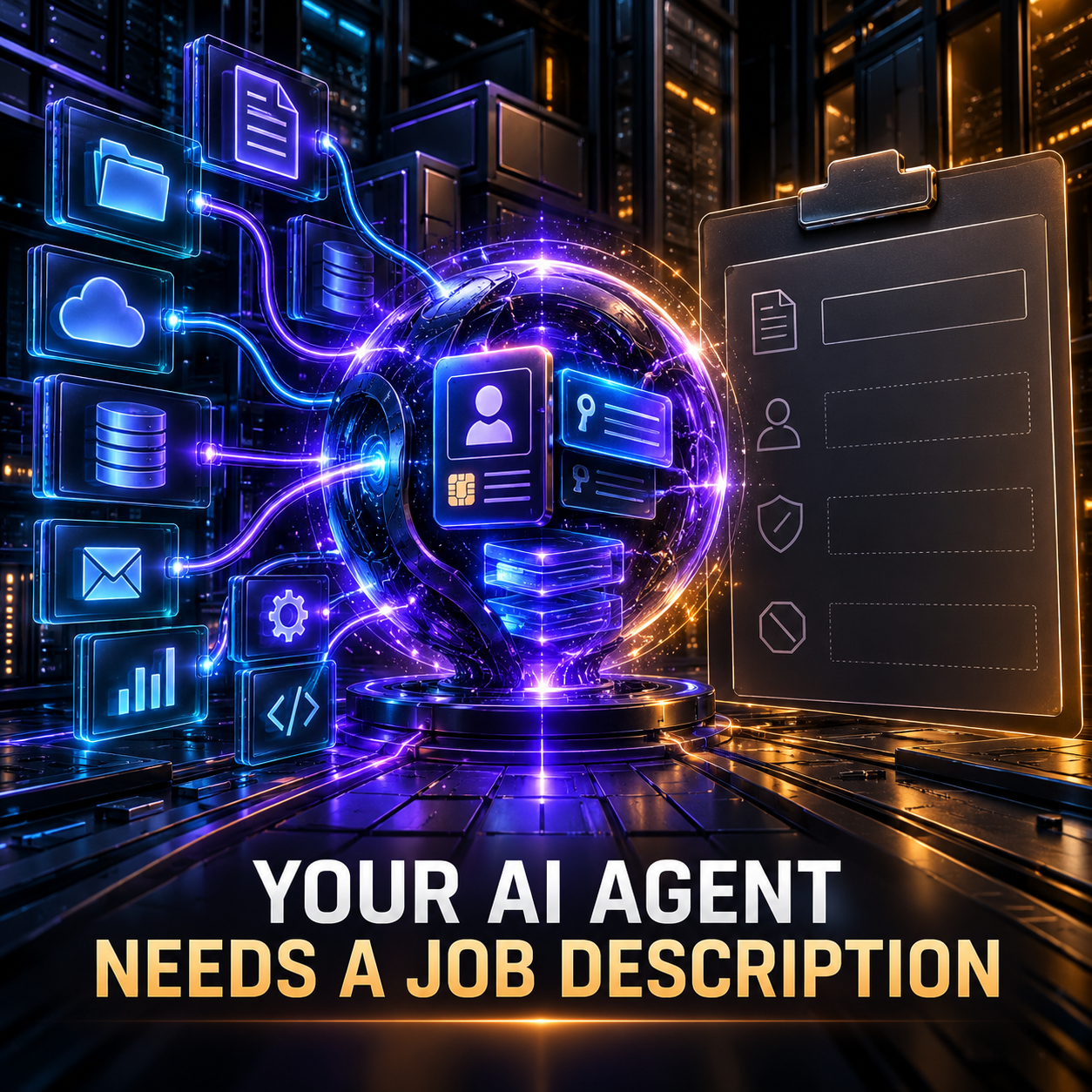
Your AI Agent Needs a Job Description
Enterprises are handing AI agents credentials, tools, and delegated authority before anyone defines the job. Identity tells you which agent acted. A job description determines whether it should have acted at all.
agile
3
articles

Governance Without the Monolith
Governance is not the enemy of hybrid delivery. Bad governance is. Regulated technology organizations need controls that increase confidence without crushing flow.

Stop Blaming the Handoff — Your Delivery Model Is Broken
The handoff problem in hybrid delivery is not a communication problem. It is a system design failure — especially in Financial Services and other regulated industries.
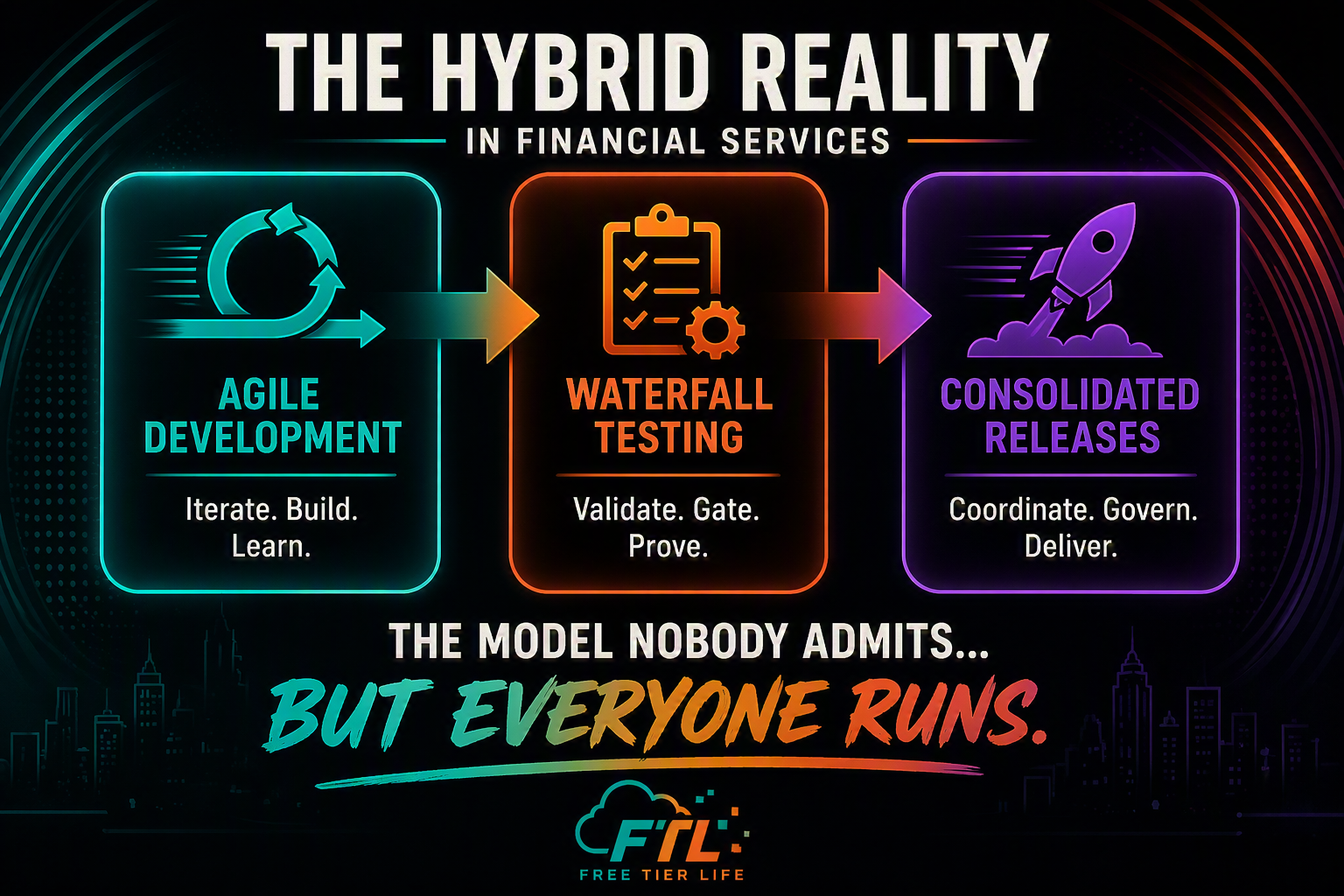
The Hybrid Reality
Why Financial Services will never be pure agile, why that is not a failure, and what a better hybrid operating model should look like.
ai
15
articles

Your AI Strategy Has a Middle-Management Problem
Executives bought the licenses. Employees got the tools. The managers in between inherited the hardest job: turning AI ambition into changed work before the intent gets lost on the way down.

When Using AI for Everything Becomes Irresponsible
AI belongs in the enterprise. AI everywhere does not. Fiscal discipline, risk management, and good engineering demand that every workload earn its place on the automation continuum.

Governance Is an Engine, Not a Brake
98% of large enterprises have an AI governance policy. Almost half have skipped it when a deployment got urgent. The research is clear on what separates governance that accelerates delivery from governance that just makes it late.

More Code, Fewer Releases: AI Moved Your Bottleneck to Testing
AI made writing code cheap. It did nothing for the review queue, the shared test environment, or the release calendar. In hybrid delivery shops, the extra code lands in testing, and it lands hard.
AI Trust Is Execution Discipline: Why Governance Has to Move Into the Workflow
AI trust is built through execution discipline: ownership, controls, evidence, auditability, human review, monitoring, and value measurement embedded directly into the work.
Who Pulls the Plug? Kill Switches, Sandboxes, and Runtime Enforcement for AI Agents
Late September 2026 made it official: telling an agent to stay in its lane was never a control. The enterprises that scale agents safely will be the ones that can stop them from the outside, quickly, and on purpose.
Your AI Agent Needs a Job Description
Enterprises are handing AI agents credentials, tools, and delegated authority before anyone defines the job. Identity tells you which agent acted. A job description determines whether it should have acted at all.
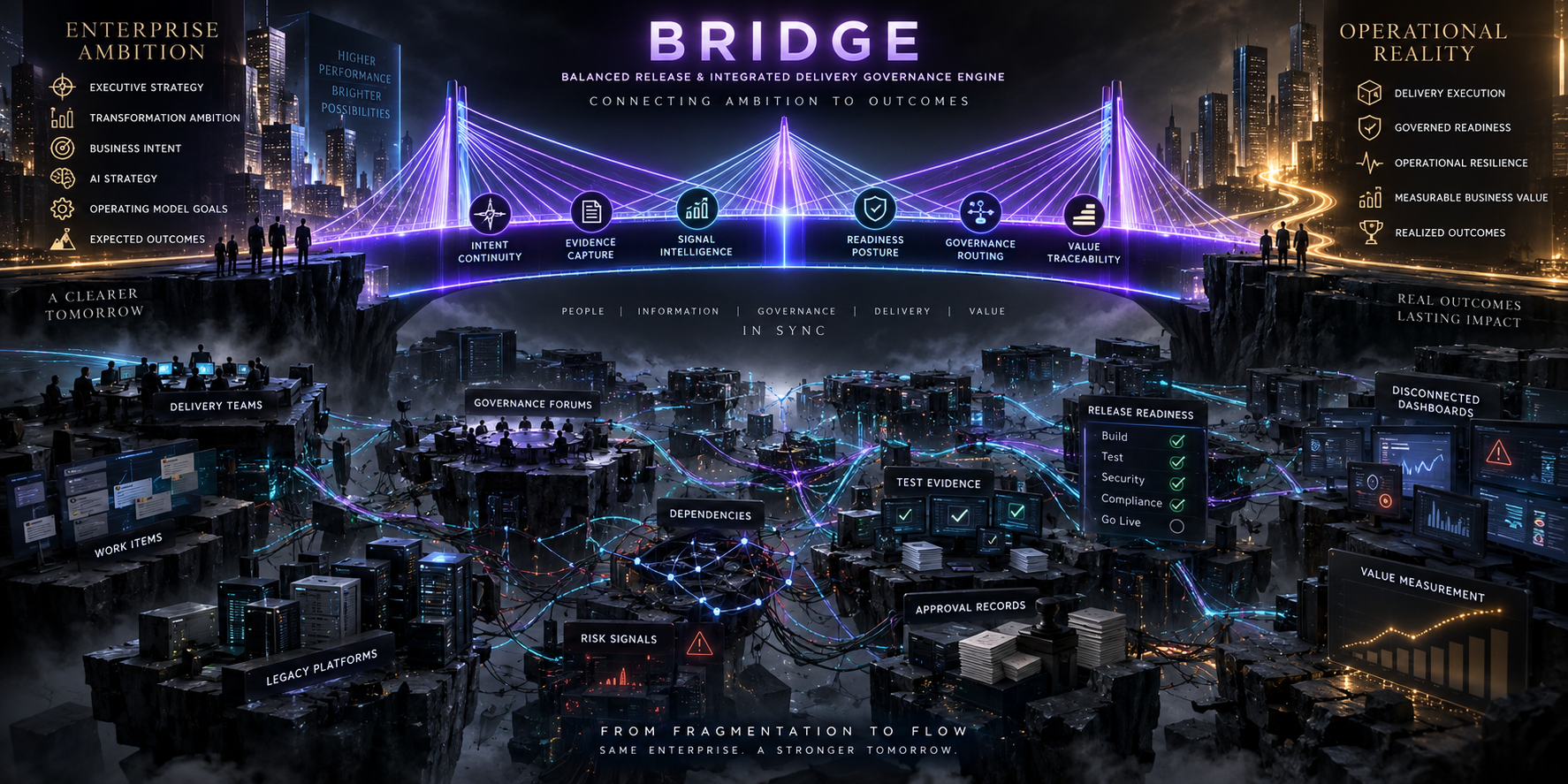
The Enterprise Doesn’t Need Another Framework. It Needs a BRIDGE.
Complex enterprises do not fail because they lack frameworks. They fail because strategy, execution, governance, evidence, signals, and value remain disconnected.
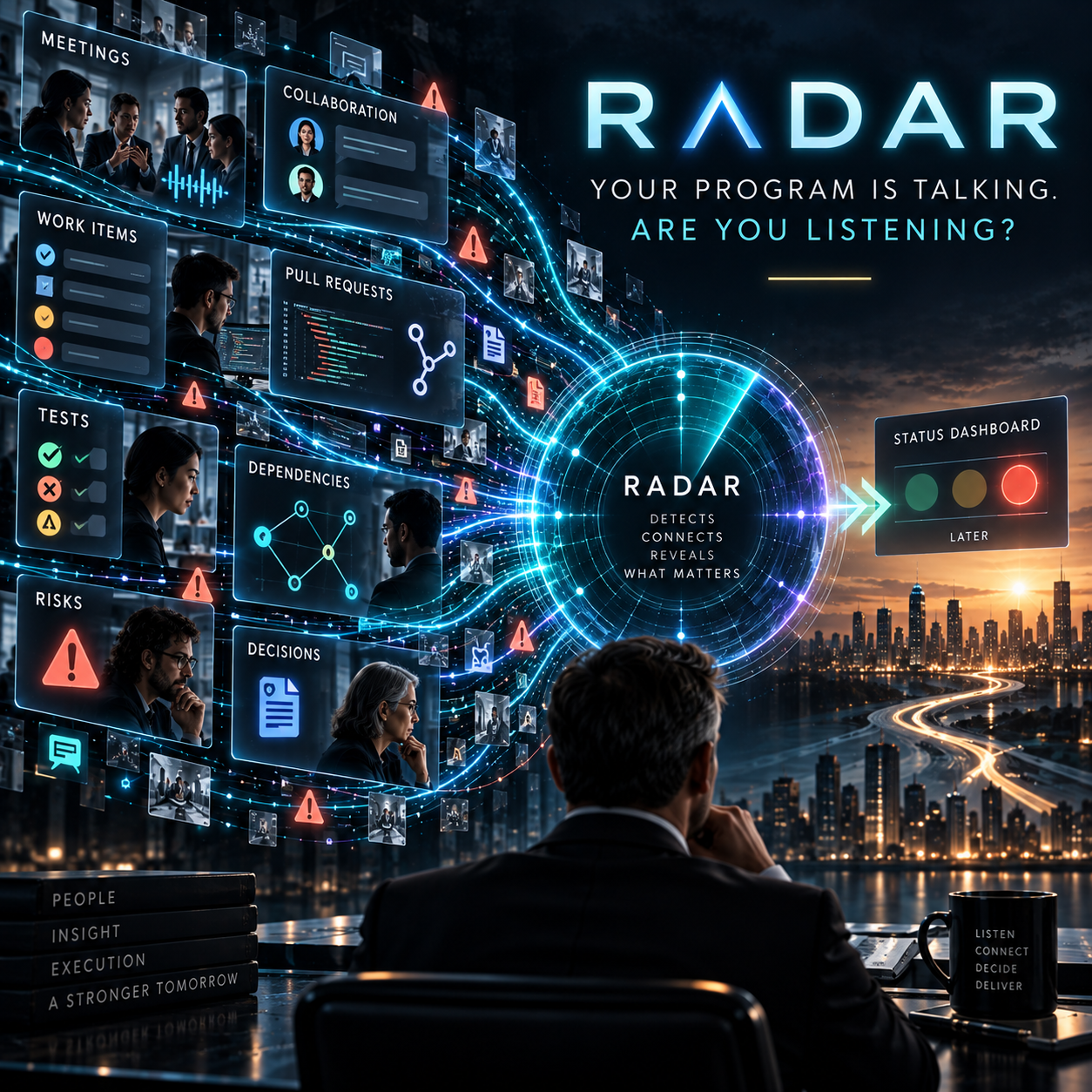
RADAR: Your Program Is Talking. Are You Listening?
Enterprise programs produce warning signals all day long. RADAR is a program intelligence concept for detecting, classifying, correlating, and escalating those signals before the status deck develops a sudden interest in reality.
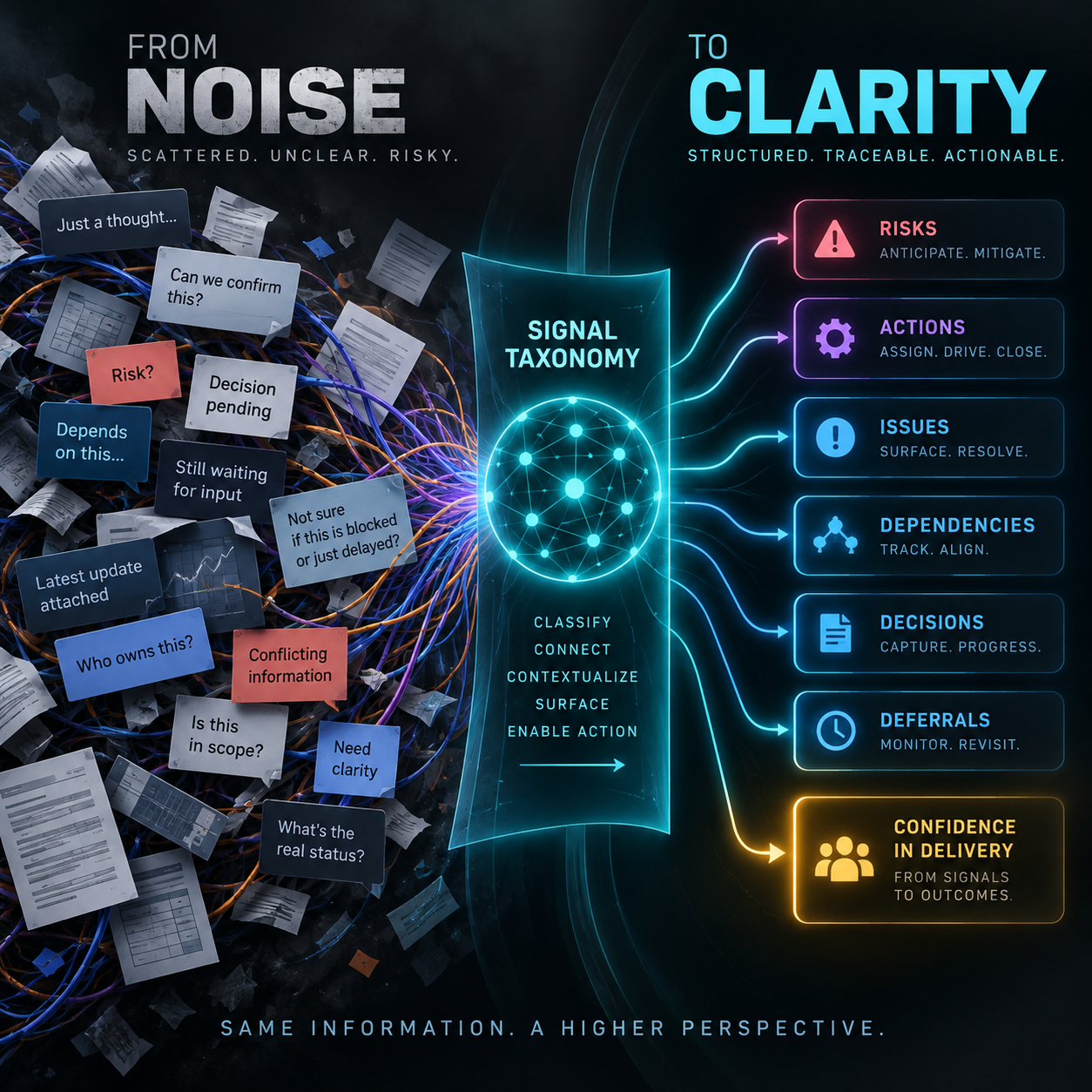
The Signal Taxonomy: A Classification Framework for Program Intelligence
Complex programs do not suffer from a shortage of information. They suffer from a classification problem. A shared signal taxonomy turns scattered delivery language into intelligence that people, analytics, automation, and AI can act on.
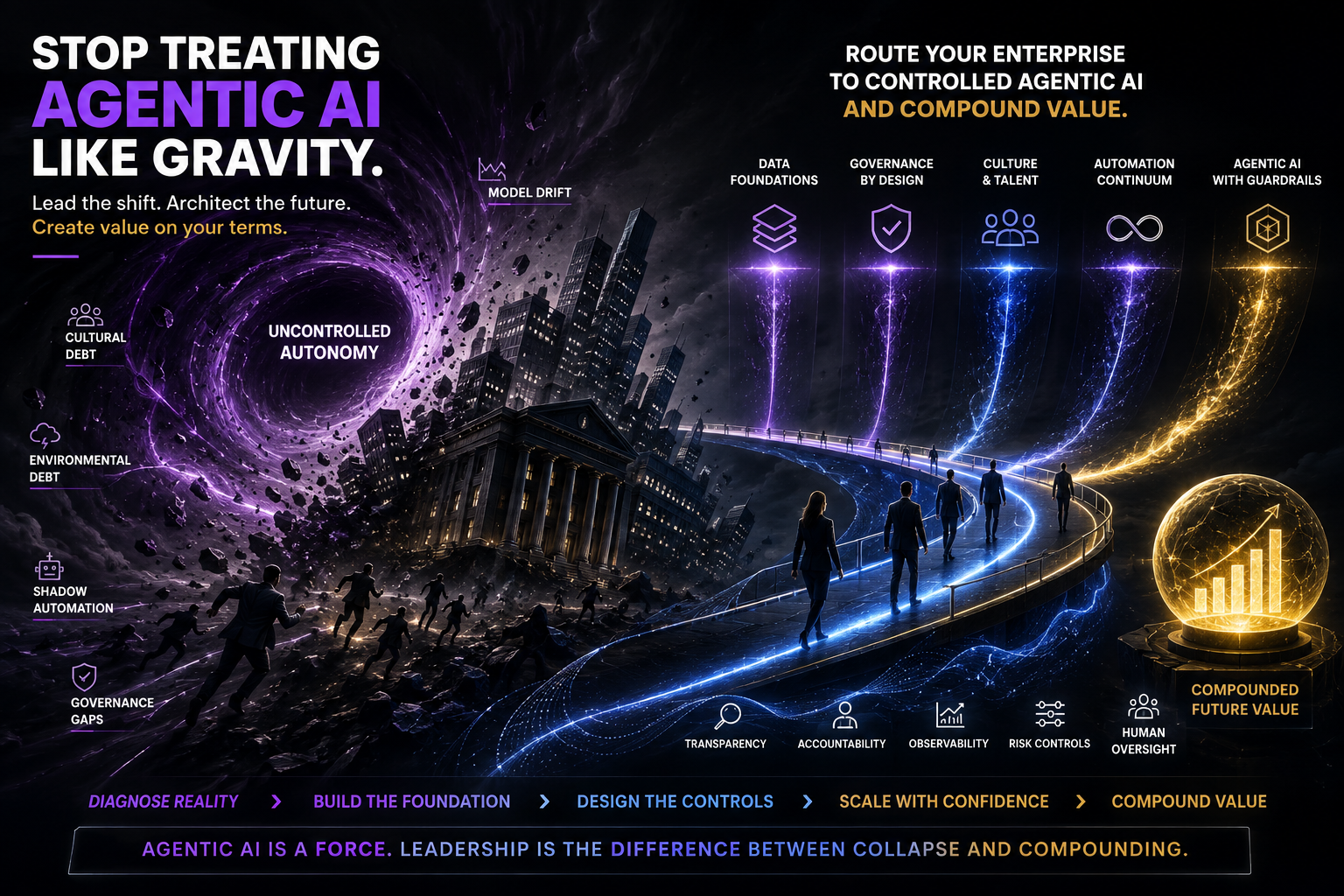
Stop Treating Agentic AI Like Gravity: Optimize for Future-Proofing, Not Speed-to-Agent
Agentic AI may matter a lot. That does not mean Financial Services should sprint toward maximum autonomy. The more responsible mandate is maximum future-proofing: better data, stronger governance, healthier culture, cleaner automation, and agentic capability only where the work earns it.
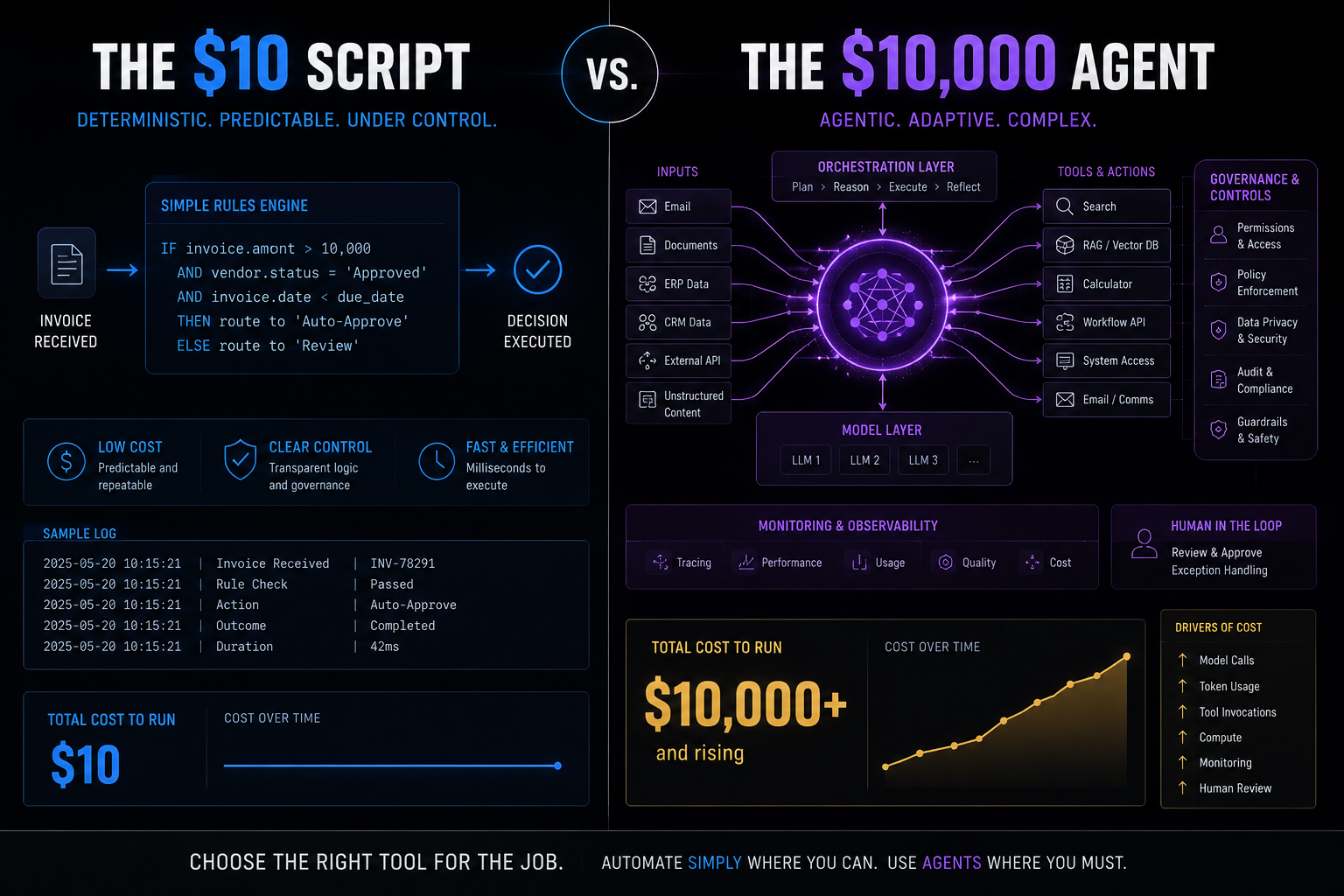
The $10 Script vs. the $10,000 Agent: A Decision Framework for Enterprise Automation
Agentic AI is powerful, but not every automation problem deserves an autonomous reasoning system with a cloud bill. Financial Services leaders need a practical way to route work across scripts, rules, workflows, generative AI, and agents.
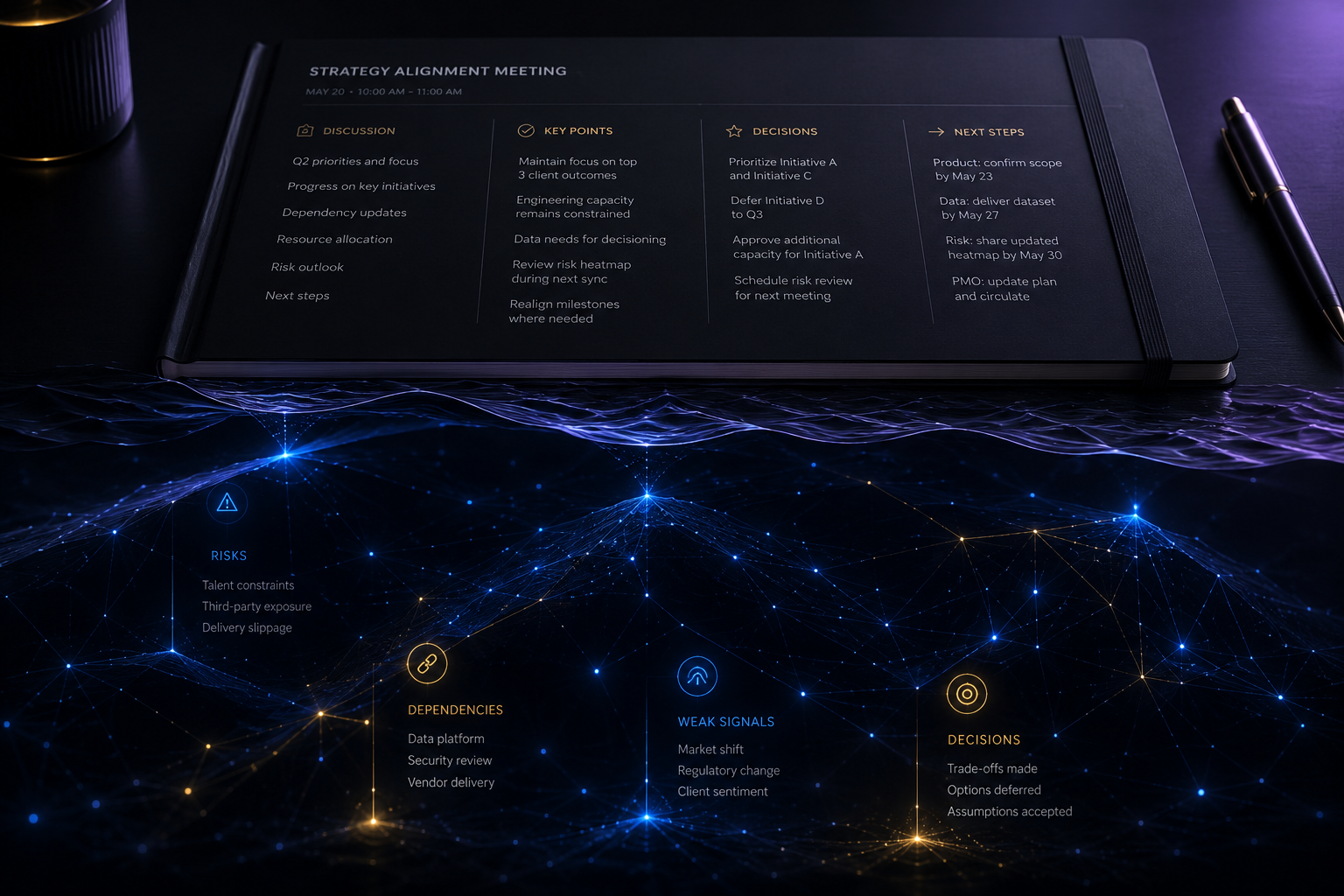
Beyond Meeting Notes: Why Enterprise Programs Need an Intelligence Engine
Enterprise programs do not fail because nobody took notes. They fail because critical signals are buried across meetings, tools, dashboards, dependencies, and decisions — and nobody can assemble the truth fast enough.
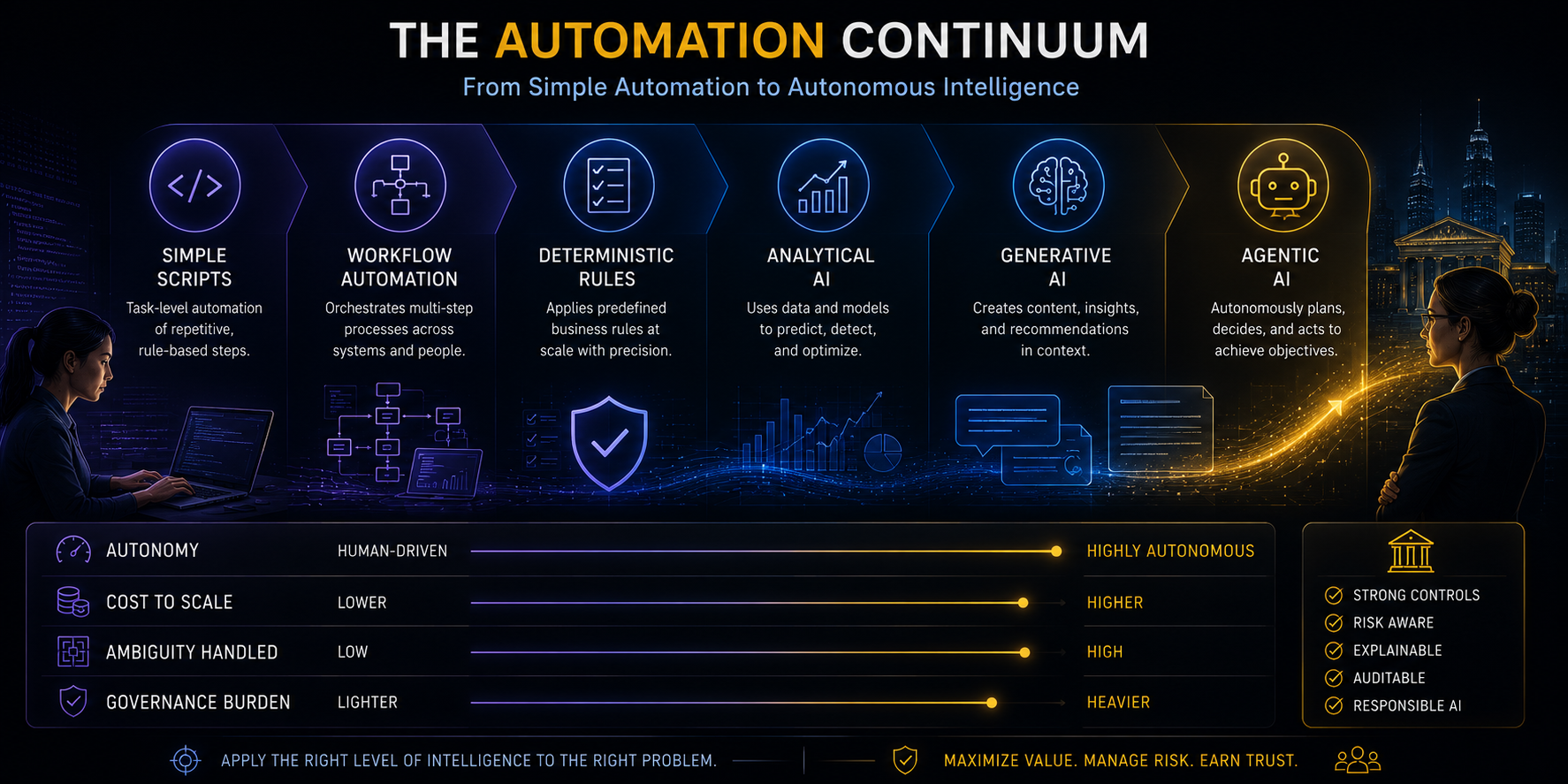
Stop Throwing Agents at Problems a Script Could Solve
Enterprises are racing toward agentic AI, but the smartest automation strategy is not agentic everything. It is matching each workload to the cheapest, safest, most auditable automation pattern that can actually do the job.
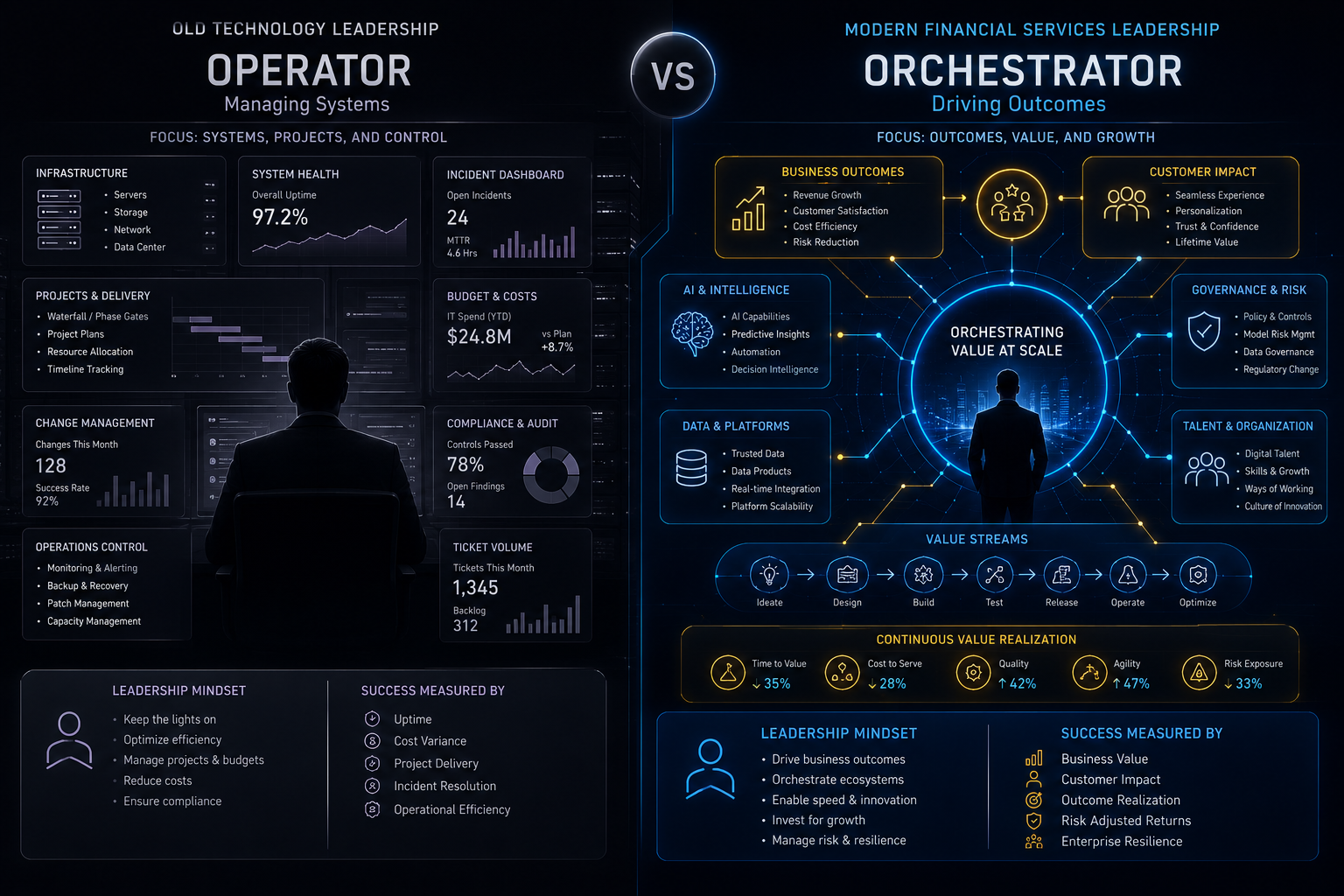
Orchestrators, Not Operators: What Financial Services Needs from Technology Leaders Right Now
Technology leadership in Financial Services has moved beyond running systems. In the AI-forward enterprise, leaders must orchestrate outcomes across strategy, delivery, governance, risk, data, talent, and value.
artificial intelligence
2
articles

The Mid-Market Technology Advantage Nobody Talks About
A practical argument for why disciplined mid-market companies can outperform larger competitors in AI, automation, modernization, cybersecurity, and technology-enabled growth by exploiting focus, speed, proximity, and constraint.

The Technology Strategy You Can Actually Afford
A practical technology strategy for organizations without infinite budgets: establish the spend baseline, protect the non-negotiables, simplify the estate, fund differentiated capabilities, govern variable costs, and force every major bet to earn the next dollar.
automation
6
articles
The Mid-Market Technology Advantage Nobody Talks About
A practical argument for why disciplined mid-market companies can outperform larger competitors in AI, automation, modernization, cybersecurity, and technology-enabled growth by exploiting focus, speed, proximity, and constraint.
RADAR: Your Program Is Talking. Are You Listening?
Enterprise programs produce warning signals all day long. RADAR is a program intelligence concept for detecting, classifying, correlating, and escalating those signals before the status deck develops a sudden interest in reality.
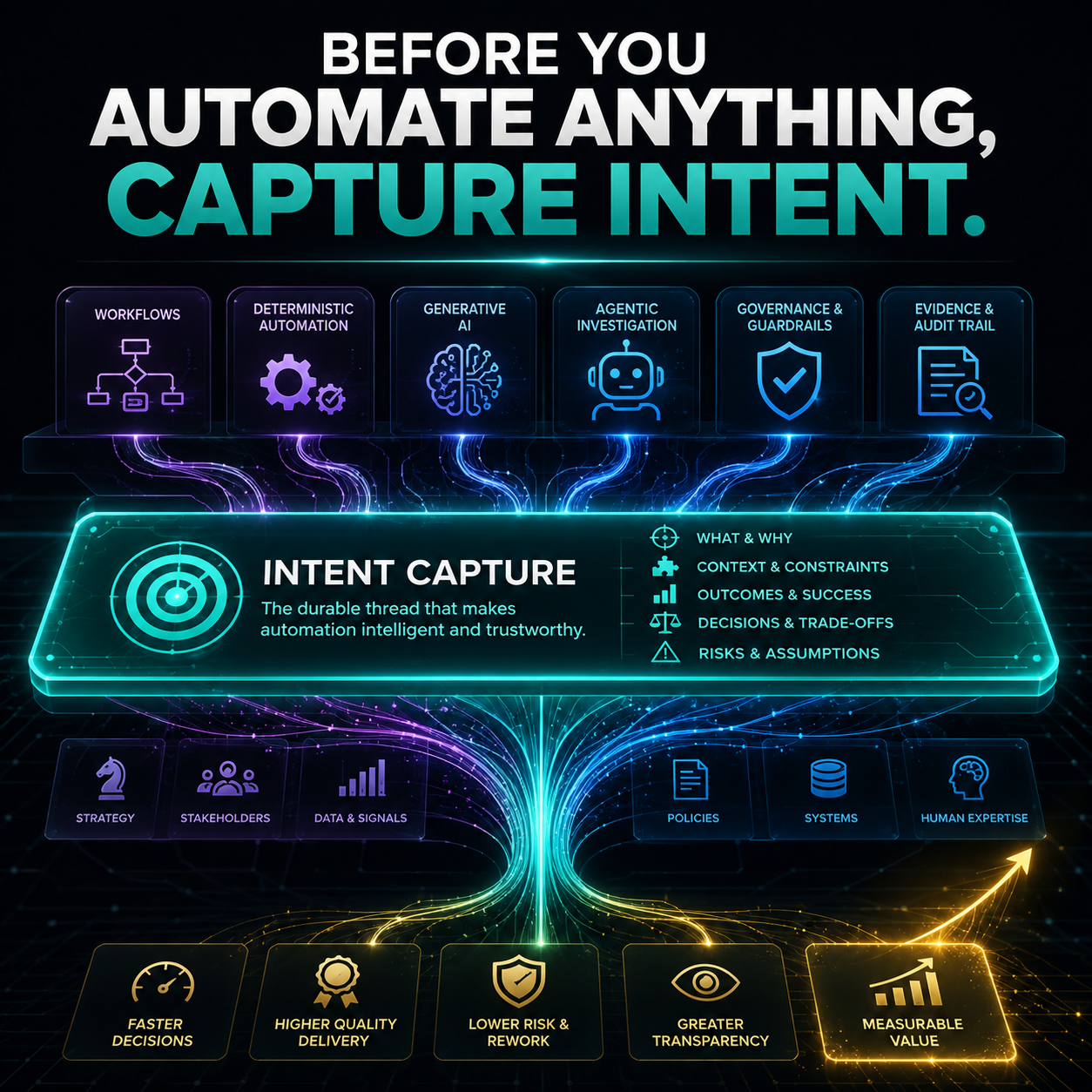
CLEAR: Before You Automate Anything, Capture Intent
Automation is dangerous when the enterprise forgets what the work was supposed to accomplish. Before agents, workflows, dashboards, governance, or reporting start optimizing activity, organizations need a disciplined way to capture intent.
The $10 Script vs. the $10,000 Agent: A Decision Framework for Enterprise Automation
Agentic AI is powerful, but not every automation problem deserves an autonomous reasoning system with a cloud bill. Financial Services leaders need a practical way to route work across scripts, rules, workflows, generative AI, and agents.
Beyond Meeting Notes: Why Enterprise Programs Need an Intelligence Engine
Enterprise programs do not fail because nobody took notes. They fail because critical signals are buried across meetings, tools, dashboards, dependencies, and decisions — and nobody can assemble the truth fast enough.
Stop Throwing Agents at Problems a Script Could Solve
Enterprises are racing toward agentic AI, but the smartest automation strategy is not agentic everything. It is matching each workload to the cheapest, safest, most auditable automation pattern that can actually do the job.
automation continuum
1
article
automation strategy
1
article
automation-continuum
3
articles
When Using AI for Everything Becomes Irresponsible
AI belongs in the enterprise. AI everywhere does not. Fiscal discipline, risk management, and good engineering demand that every workload earn its place on the automation continuum.
Stop Treating Agentic AI Like Gravity: Optimize for Future-Proofing, Not Speed-to-Agent
Agentic AI may matter a lot. That does not mean Financial Services should sprint toward maximum autonomy. The more responsible mandate is maximum future-proofing: better data, stronger governance, healthier culture, cleaner automation, and agentic capability only where the work earns it.
The $10 Script vs. the $10,000 Agent: A Decision Framework for Enterprise Automation
Agentic AI is powerful, but not every automation problem deserves an autonomous reasoning system with a cloud bill. Financial Services leaders need a practical way to route work across scripts, rules, workflows, generative AI, and agents.
bridge
4
articles
Governance Is an Engine, Not a Brake
98% of large enterprises have an AI governance policy. Almost half have skipped it when a deployment got urgent. The research is clear on what separates governance that accelerates delivery from governance that just makes it late.
The Enterprise Doesn’t Need Another Framework. It Needs a BRIDGE.
Complex enterprises do not fail because they lack frameworks. They fail because strategy, execution, governance, evidence, signals, and value remain disconnected.
RADAR: Your Program Is Talking. Are You Listening?
Enterprise programs produce warning signals all day long. RADAR is a program intelligence concept for detecting, classifying, correlating, and escalating those signals before the status deck develops a sudden interest in reality.
CLEAR: Before You Automate Anything, Capture Intent
Automation is dangerous when the enterprise forgets what the work was supposed to accomplish. Before agents, workflows, dashboards, governance, or reporting start optimizing activity, organizations need a disciplined way to capture intent.
business value
1
article
capital allocation
2
articles
The Mid-Market Technology Advantage Nobody Talks About
A practical argument for why disciplined mid-market companies can outperform larger competitors in AI, automation, modernization, cybersecurity, and technology-enabled growth by exploiting focus, speed, proximity, and constraint.
The Technology Strategy You Can Actually Afford
A practical technology strategy for organizations without infinite budgets: establish the spend baseline, protect the non-negotiables, simplify the estate, fund differentiated capabilities, govern variable costs, and force every major bet to earn the next dollar.
culture
2
articles
Your AI Strategy Has a Middle-Management Problem
Executives bought the licenses. Employees got the tools. The managers in between inherited the hardest job: turning AI ambition into changed work before the intent gets lost on the way down.

The Leadership Debt Always Comes Due
Transformation does not fail only because the architecture was messy or the roadmap was wrong. It fails because leaders accumulate debt in clarity, trust, accountability, empathy, and decision discipline. Eventually, the delivery system collects.
cybersecurity
3
articles

The Five Technology Questions Every Board Should Ask Right Now
Boards do not need to become architects. They do need to ask management five uncomfortable questions that expose whether technology is creating value, accumulating risk, or simply getting better at producing slides.
The Mid-Market Technology Advantage Nobody Talks About
A practical argument for why disciplined mid-market companies can outperform larger competitors in AI, automation, modernization, cybersecurity, and technology-enabled growth by exploiting focus, speed, proximity, and constraint.
The Technology Strategy You Can Actually Afford
A practical technology strategy for organizations without infinite budgets: establish the spend baseline, protect the non-negotiables, simplify the estate, fund differentiated capabilities, govern variable costs, and force every major bet to earn the next dollar.
data visualization
1
article
decision intelligence
1
article
decision making
1
article
delivery
3
articles
Governance Without the Monolith
Governance is not the enemy of hybrid delivery. Bad governance is. Regulated technology organizations need controls that increase confidence without crushing flow.
Stop Blaming the Handoff — Your Delivery Model Is Broken
The handoff problem in hybrid delivery is not a communication problem. It is a system design failure — especially in Financial Services and other regulated industries.
The Hybrid Reality
Why Financial Services will never be pure agile, why that is not a failure, and what a better hybrid operating model should look like.
delivery-culture
1
article
digital transformation
1
article
enterprise architecture
1
article
enterprise transformation
1
article
enterprise-technology
2
articles
When Using AI for Everything Becomes Irresponsible
AI belongs in the enterprise. AI everywhere does not. Fiscal discipline, risk management, and good engineering demand that every workload earn its place on the automation continuum.
Stop Throwing Agents at Problems a Script Could Solve
Enterprises are racing toward agentic AI, but the smartest automation strategy is not agentic everything. It is matching each workload to the cheapest, safest, most auditable automation pattern that can actually do the job.
enterprise-transformation
1
article
financial services
1
article
financial-services
18
articles
Your AI Strategy Has a Middle-Management Problem
Executives bought the licenses. Employees got the tools. The managers in between inherited the hardest job: turning AI ambition into changed work before the intent gets lost on the way down.

Clarity Is a Leadership Deliverable
Leadership gets romanticized as vision. In real organizations, it is often something less glamorous and more useful: reducing ambiguity enough that people can make good decisions without waiting for another meeting.
Governance Is an Engine, Not a Brake
98% of large enterprises have an AI governance policy. Almost half have skipped it when a deployment got urgent. The research is clear on what separates governance that accelerates delivery from governance that just makes it late.
More Code, Fewer Releases: AI Moved Your Bottleneck to Testing
AI made writing code cheap. It did nothing for the review queue, the shared test environment, or the release calendar. In hybrid delivery shops, the extra code lands in testing, and it lands hard.
AI Trust Is Execution Discipline: Why Governance Has to Move Into the Workflow
AI trust is built through execution discipline: ownership, controls, evidence, auditability, human review, monitoring, and value measurement embedded directly into the work.
Who Pulls the Plug? Kill Switches, Sandboxes, and Runtime Enforcement for AI Agents
Late September 2026 made it official: telling an agent to stay in its lane was never a control. The enterprises that scale agents safely will be the ones that can stop them from the outside, quickly, and on purpose.
Your AI Agent Needs a Job Description
Enterprises are handing AI agents credentials, tools, and delegated authority before anyone defines the job. Identity tells you which agent acted. A job description determines whether it should have acted at all.
RADAR: Your Program Is Talking. Are You Listening?
Enterprise programs produce warning signals all day long. RADAR is a program intelligence concept for detecting, classifying, correlating, and escalating those signals before the status deck develops a sudden interest in reality.
CLEAR: Before You Automate Anything, Capture Intent
Automation is dangerous when the enterprise forgets what the work was supposed to accomplish. Before agents, workflows, dashboards, governance, or reporting start optimizing activity, organizations need a disciplined way to capture intent.
The Signal Taxonomy: A Classification Framework for Program Intelligence
Complex programs do not suffer from a shortage of information. They suffer from a classification problem. A shared signal taxonomy turns scattered delivery language into intelligence that people, analytics, automation, and AI can act on.
Stop Treating Agentic AI Like Gravity: Optimize for Future-Proofing, Not Speed-to-Agent
Agentic AI may matter a lot. That does not mean Financial Services should sprint toward maximum autonomy. The more responsible mandate is maximum future-proofing: better data, stronger governance, healthier culture, cleaner automation, and agentic capability only where the work earns it.
The $10 Script vs. the $10,000 Agent: A Decision Framework for Enterprise Automation
Agentic AI is powerful, but not every automation problem deserves an autonomous reasoning system with a cloud bill. Financial Services leaders need a practical way to route work across scripts, rules, workflows, generative AI, and agents.
Beyond Meeting Notes: Why Enterprise Programs Need an Intelligence Engine
Enterprise programs do not fail because nobody took notes. They fail because critical signals are buried across meetings, tools, dashboards, dependencies, and decisions — and nobody can assemble the truth fast enough.
Stop Throwing Agents at Problems a Script Could Solve
Enterprises are racing toward agentic AI, but the smartest automation strategy is not agentic everything. It is matching each workload to the cheapest, safest, most auditable automation pattern that can actually do the job.
Orchestrators, Not Operators: What Financial Services Needs from Technology Leaders Right Now
Technology leadership in Financial Services has moved beyond running systems. In the AI-forward enterprise, leaders must orchestrate outcomes across strategy, delivery, governance, risk, data, talent, and value.
Governance Without the Monolith
Governance is not the enemy of hybrid delivery. Bad governance is. Regulated technology organizations need controls that increase confidence without crushing flow.
Stop Blaming the Handoff — Your Delivery Model Is Broken
The handoff problem in hybrid delivery is not a communication problem. It is a system design failure — especially in Financial Services and other regulated industries.
The Hybrid Reality
Why Financial Services will never be pure agile, why that is not a failure, and what a better hybrid operating model should look like.
governance
9
articles
Governance Is an Engine, Not a Brake
98% of large enterprises have an AI governance policy. Almost half have skipped it when a deployment got urgent. The research is clear on what separates governance that accelerates delivery from governance that just makes it late.
AI Trust Is Execution Discipline: Why Governance Has to Move Into the Workflow
AI trust is built through execution discipline: ownership, controls, evidence, auditability, human review, monitoring, and value measurement embedded directly into the work.
Who Pulls the Plug? Kill Switches, Sandboxes, and Runtime Enforcement for AI Agents
Late September 2026 made it official: telling an agent to stay in its lane was never a control. The enterprises that scale agents safely will be the ones that can stop them from the outside, quickly, and on purpose.
Your AI Agent Needs a Job Description
Enterprises are handing AI agents credentials, tools, and delegated authority before anyone defines the job. Identity tells you which agent acted. A job description determines whether it should have acted at all.
The Enterprise Doesn’t Need Another Framework. It Needs a BRIDGE.
Complex enterprises do not fail because they lack frameworks. They fail because strategy, execution, governance, evidence, signals, and value remain disconnected.
The Signal Taxonomy: A Classification Framework for Program Intelligence
Complex programs do not suffer from a shortage of information. They suffer from a classification problem. A shared signal taxonomy turns scattered delivery language into intelligence that people, analytics, automation, and AI can act on.
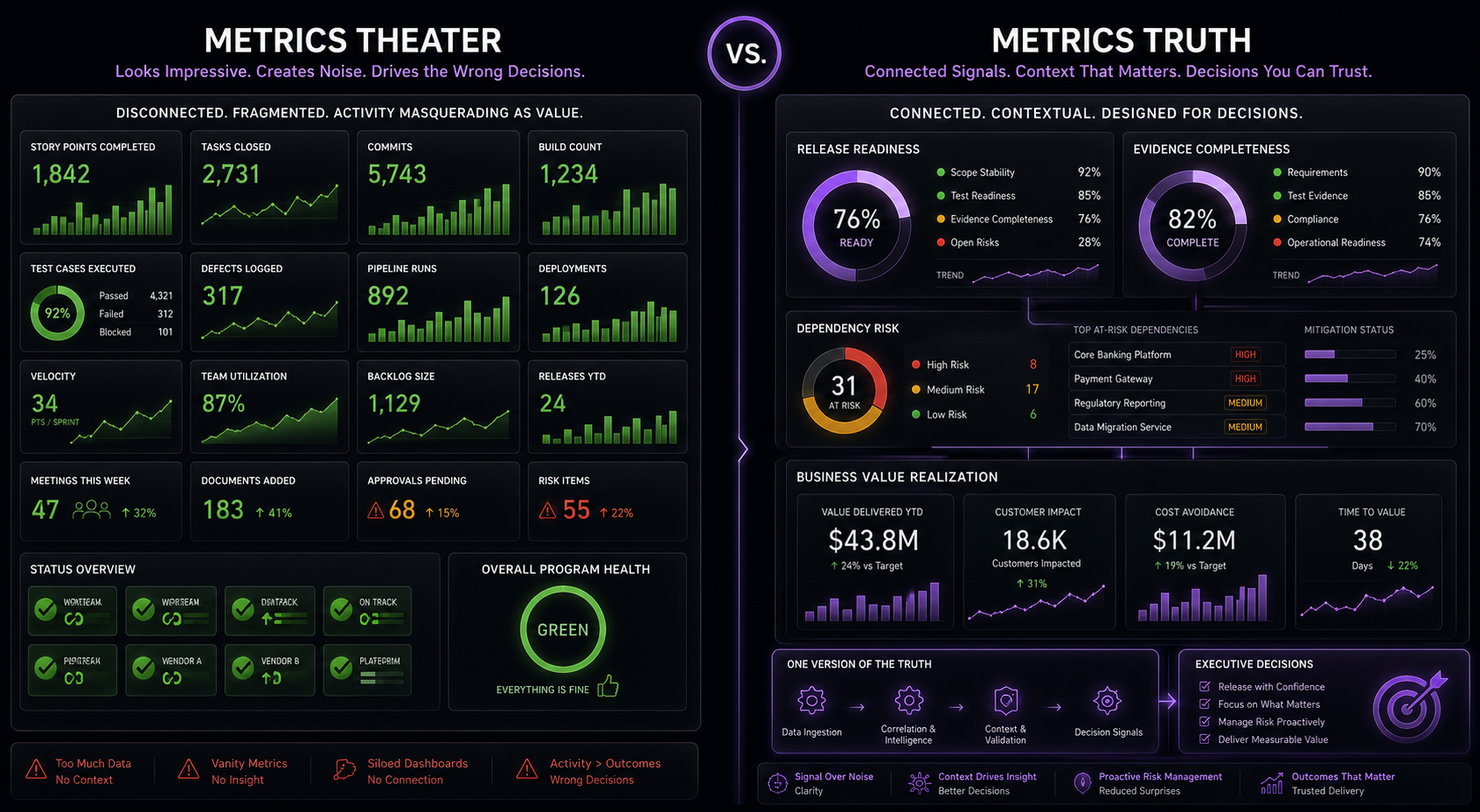
Metrics That Matter: Release Readiness, Business Value, and the End of Dashboard Theater
Governance Without the Monolith
Governance is not the enemy of hybrid delivery. Bad governance is. Regulated technology organizations need controls that increase confidence without crushing flow.
Stop Blaming the Handoff — Your Delivery Model Is Broken
The handoff problem in hybrid delivery is not a communication problem. It is a system design failure — especially in Financial Services and other regulated industries.
human-centered-ai
1
article
hybrid delivery
1
article
leadership
6
articles
Your AI Strategy Has a Middle-Management Problem
Executives bought the licenses. Employees got the tools. The managers in between inherited the hardest job: turning AI ambition into changed work before the intent gets lost on the way down.

The Dashboard Is Not the Decision
Enterprises are drowning in dashboards and starving for decisions. The problem isn't visualization. It's the missing connective tissue between signal, threshold, ownership, decision, and action.
Clarity Is a Leadership Deliverable
Leadership gets romanticized as vision. In real organizations, it is often something less glamorous and more useful: reducing ambiguity enough that people can make good decisions without waiting for another meeting.
Stop Treating Agentic AI Like Gravity: Optimize for Future-Proofing, Not Speed-to-Agent
Agentic AI may matter a lot. That does not mean Financial Services should sprint toward maximum autonomy. The more responsible mandate is maximum future-proofing: better data, stronger governance, healthier culture, cleaner automation, and agentic capability only where the work earns it.
The Leadership Debt Always Comes Due
Transformation does not fail only because the architecture was messy or the roadmap was wrong. It fails because leaders accumulate debt in clarity, trust, accountability, empathy, and decision discipline. Eventually, the delivery system collects.
Orchestrators, Not Operators: What Financial Services Needs from Technology Leaders Right Now
Technology leadership in Financial Services has moved beyond running systems. In the AI-forward enterprise, leaders must orchestrate outcomes across strategy, delivery, governance, risk, data, talent, and value.

metrics
2
articles
The Dashboard Is Not the Decision
Enterprises are drowning in dashboards and starving for decisions. The problem isn't visualization. It's the missing connective tissue between signal, threshold, ownership, decision, and action.
Metrics That Matter: Release Readiness, Business Value, and the End of Dashboard Theater
mid-market technology strategy
2
articles
The Mid-Market Technology Advantage Nobody Talks About
A practical argument for why disciplined mid-market companies can outperform larger competitors in AI, automation, modernization, cybersecurity, and technology-enabled growth by exploiting focus, speed, proximity, and constraint.

You Don't Need Another AI Moonshot. You Need Something That Pays for One.
A pragmatic technology leadership model for using measurable operational improvements to fund bigger AI and transformation ambitions without starting with an expensive moonshot.
modernization
2
articles
The Mid-Market Technology Advantage Nobody Talks About
A practical argument for why disciplined mid-market companies can outperform larger competitors in AI, automation, modernization, cybersecurity, and technology-enabled growth by exploiting focus, speed, proximity, and constraint.
The Technology Strategy You Can Actually Afford
A practical technology strategy for organizations without infinite budgets: establish the spend baseline, protect the non-negotiables, simplify the estate, fund differentiated capabilities, govern variable costs, and force every major bet to earn the next dollar.
operating model
1
article
program-intelligence
4
articles
RADAR: Your Program Is Talking. Are You Listening?
Enterprise programs produce warning signals all day long. RADAR is a program intelligence concept for detecting, classifying, correlating, and escalating those signals before the status deck develops a sudden interest in reality.
CLEAR: Before You Automate Anything, Capture Intent
Automation is dangerous when the enterprise forgets what the work was supposed to accomplish. Before agents, workflows, dashboards, governance, or reporting start optimizing activity, organizations need a disciplined way to capture intent.
The Signal Taxonomy: A Classification Framework for Program Intelligence
Complex programs do not suffer from a shortage of information. They suffer from a classification problem. A shared signal taxonomy turns scattered delivery language into intelligence that people, analytics, automation, and AI can act on.
Beyond Meeting Notes: Why Enterprise Programs Need an Intelligence Engine
Enterprise programs do not fail because nobody took notes. They fail because critical signals are buried across meetings, tools, dashboards, dependencies, and decisions — and nobody can assemble the truth fast enough.
release readiness
1
article
software-delivery
2
articles

AI Without Messing Up the Culture: The Human Side of SDLC 2.0
AI should make software delivery clearer, faster, safer, and more human. If it makes the culture worse, you did not modernize the SDLC. You automated the dysfunction.
More Code, Fewer Releases: AI Moved Your Bottleneck to Testing
AI made writing code cheap. It did nothing for the review queue, the shared test environment, or the release calendar. In hybrid delivery shops, the extra code lands in testing, and it lands hard.
technical debt
2
articles
The Five Technology Questions Every Board Should Ask Right Now
Boards do not need to become architects. They do need to ask management five uncomfortable questions that expose whether technology is creating value, accumulating risk, or simply getting better at producing slides.
The Technology Strategy You Can Actually Afford
A practical technology strategy for organizations without infinite budgets: establish the spend baseline, protect the non-negotiables, simplify the estate, fund differentiated capabilities, govern variable costs, and force every major bet to earn the next dollar.
technology economics
2
articles
The Mid-Market Technology Advantage Nobody Talks About
A practical argument for why disciplined mid-market companies can outperform larger competitors in AI, automation, modernization, cybersecurity, and technology-enabled growth by exploiting focus, speed, proximity, and constraint.
The Technology Strategy You Can Actually Afford
A practical technology strategy for organizations without infinite budgets: establish the spend baseline, protect the non-negotiables, simplify the estate, fund differentiated capabilities, govern variable costs, and force every major bet to earn the next dollar.
technology investment
1
article
technology leadership
3
articles
The Five Technology Questions Every Board Should Ask Right Now
Boards do not need to become architects. They do need to ask management five uncomfortable questions that expose whether technology is creating value, accumulating risk, or simply getting better at producing slides.
The Mid-Market Technology Advantage Nobody Talks About
A practical argument for why disciplined mid-market companies can outperform larger competitors in AI, automation, modernization, cybersecurity, and technology-enabled growth by exploiting focus, speed, proximity, and constraint.
You Don't Need Another AI Moonshot. You Need Something That Pays for One.
A pragmatic technology leadership model for using measurable operational improvements to fund bigger AI and transformation ambitions without starting with an expensive moonshot.
technology strategy
2
articles
The Five Technology Questions Every Board Should Ask Right Now
Boards do not need to become architects. They do need to ask management five uncomfortable questions that expose whether technology is creating value, accumulating risk, or simply getting better at producing slides.
The Technology Strategy You Can Actually Afford
A practical technology strategy for organizations without infinite budgets: establish the spend baseline, protect the non-negotiables, simplify the estate, fund differentiated capabilities, govern variable costs, and force every major bet to earn the next dollar.
thought-leadership
22
articles
AI Without Messing Up the Culture: The Human Side of SDLC 2.0
AI should make software delivery clearer, faster, safer, and more human. If it makes the culture worse, you did not modernize the SDLC. You automated the dysfunction.
Your AI Strategy Has a Middle-Management Problem
Executives bought the licenses. Employees got the tools. The managers in between inherited the hardest job: turning AI ambition into changed work before the intent gets lost on the way down.
When Using AI for Everything Becomes Irresponsible
AI belongs in the enterprise. AI everywhere does not. Fiscal discipline, risk management, and good engineering demand that every workload earn its place on the automation continuum.
Clarity Is a Leadership Deliverable
Leadership gets romanticized as vision. In real organizations, it is often something less glamorous and more useful: reducing ambiguity enough that people can make good decisions without waiting for another meeting.
Governance Is an Engine, Not a Brake
98% of large enterprises have an AI governance policy. Almost half have skipped it when a deployment got urgent. The research is clear on what separates governance that accelerates delivery from governance that just makes it late.
More Code, Fewer Releases: AI Moved Your Bottleneck to Testing
AI made writing code cheap. It did nothing for the review queue, the shared test environment, or the release calendar. In hybrid delivery shops, the extra code lands in testing, and it lands hard.
AI Trust Is Execution Discipline: Why Governance Has to Move Into the Workflow
AI trust is built through execution discipline: ownership, controls, evidence, auditability, human review, monitoring, and value measurement embedded directly into the work.
Who Pulls the Plug? Kill Switches, Sandboxes, and Runtime Enforcement for AI Agents
Late September 2026 made it official: telling an agent to stay in its lane was never a control. The enterprises that scale agents safely will be the ones that can stop them from the outside, quickly, and on purpose.
Your AI Agent Needs a Job Description
Enterprises are handing AI agents credentials, tools, and delegated authority before anyone defines the job. Identity tells you which agent acted. A job description determines whether it should have acted at all.
The Enterprise Doesn’t Need Another Framework. It Needs a BRIDGE.
Complex enterprises do not fail because they lack frameworks. They fail because strategy, execution, governance, evidence, signals, and value remain disconnected.
RADAR: Your Program Is Talking. Are You Listening?
Enterprise programs produce warning signals all day long. RADAR is a program intelligence concept for detecting, classifying, correlating, and escalating those signals before the status deck develops a sudden interest in reality.
CLEAR: Before You Automate Anything, Capture Intent
Automation is dangerous when the enterprise forgets what the work was supposed to accomplish. Before agents, workflows, dashboards, governance, or reporting start optimizing activity, organizations need a disciplined way to capture intent.
The Signal Taxonomy: A Classification Framework for Program Intelligence
Complex programs do not suffer from a shortage of information. They suffer from a classification problem. A shared signal taxonomy turns scattered delivery language into intelligence that people, analytics, automation, and AI can act on.
Stop Treating Agentic AI Like Gravity: Optimize for Future-Proofing, Not Speed-to-Agent
Agentic AI may matter a lot. That does not mean Financial Services should sprint toward maximum autonomy. The more responsible mandate is maximum future-proofing: better data, stronger governance, healthier culture, cleaner automation, and agentic capability only where the work earns it.
The $10 Script vs. the $10,000 Agent: A Decision Framework for Enterprise Automation
Agentic AI is powerful, but not every automation problem deserves an autonomous reasoning system with a cloud bill. Financial Services leaders need a practical way to route work across scripts, rules, workflows, generative AI, and agents.
The Leadership Debt Always Comes Due
Transformation does not fail only because the architecture was messy or the roadmap was wrong. It fails because leaders accumulate debt in clarity, trust, accountability, empathy, and decision discipline. Eventually, the delivery system collects.
Beyond Meeting Notes: Why Enterprise Programs Need an Intelligence Engine
Enterprise programs do not fail because nobody took notes. They fail because critical signals are buried across meetings, tools, dashboards, dependencies, and decisions — and nobody can assemble the truth fast enough.
Stop Throwing Agents at Problems a Script Could Solve
Enterprises are racing toward agentic AI, but the smartest automation strategy is not agentic everything. It is matching each workload to the cheapest, safest, most auditable automation pattern that can actually do the job.
Orchestrators, Not Operators: What Financial Services Needs from Technology Leaders Right Now
Technology leadership in Financial Services has moved beyond running systems. In the AI-forward enterprise, leaders must orchestrate outcomes across strategy, delivery, governance, risk, data, talent, and value.
Governance Without the Monolith
Governance is not the enemy of hybrid delivery. Bad governance is. Regulated technology organizations need controls that increase confidence without crushing flow.
Stop Blaming the Handoff — Your Delivery Model Is Broken
The handoff problem in hybrid delivery is not a communication problem. It is a system design failure — especially in Financial Services and other regulated industries.
The Hybrid Reality
Why Financial Services will never be pure agile, why that is not a failure, and what a better hybrid operating model should look like.
transformation
3
articles
You Don't Need Another AI Moonshot. You Need Something That Pays for One.
A pragmatic technology leadership model for using measurable operational improvements to fund bigger AI and transformation ambitions without starting with an expensive moonshot.
The Leadership Debt Always Comes Due
Transformation does not fail only because the architecture was messy or the roadmap was wrong. It fails because leaders accumulate debt in clarity, trust, accountability, empathy, and decision discipline. Eventually, the delivery system collects.
Orchestrators, Not Operators: What Financial Services Needs from Technology Leaders Right Now
Technology leadership in Financial Services has moved beyond running systems. In the AI-forward enterprise, leaders must orchestrate outcomes across strategy, delivery, governance, risk, data, talent, and value.